What it was
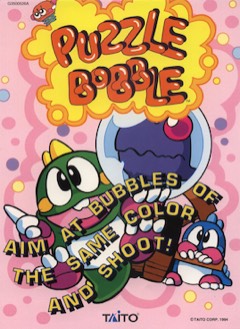
You have a pointer at the bottom of the screen and a bubble to fire. Aim it, bounce it off the side walls if you must, and stick it to the pile above. Land three or more of one colour and they pop, and anything hanging off them drops too. That is the whole game, and it is enough.
The pressure comes from above. Every few shots the ceiling lurches down, taking the whole pile with it, and the closer the bubbles get to your line the faster the music plays. Leave the pointer alone and it fires for you. The colours you are handed come only from what is still on the screen, so a clean board is a fair board.
Where it sits in history
It started as an arcade game from Taito in June 1994 under the working title Bubble Buster, released in Japan as Puzzle Bobble. It borrows the characters and cheer of Bubble Bobble, which Taito had made in 1986. A Neo Geo version followed on 21 December 1994, in stereo with some new sound effects and translated text.
The Super Famicom and SNES version arrived in Japan on 13 January 1995 and in North America that March. The arcade game did the damage first: Game Machine listed the Neo Geo version as Japan's second most popular arcade game of February 1995, and it ended the year as the country's second highest-earning arcade board, behind only Virtua Fighter 2.
How it plays today
It holds up because there is nothing to decode. You learn the rules in ten seconds and spend the next ten hours working out how to bank a shot off the wall. The second player is where it lives: Electronic Gaming Monthly called the two player mode the highlight, and called the whole thing 'thoroughly enjoyable and incredibly addicting'.
Not everyone was sold. GamePro scored it down because every one-player level starts to feel the same and a two player match is over too quickly. That is fair. Alone, it is a very good time-killer rather than a great adventure. With a mate on the couch, it is the one you refuse to put down.
Compared with
- Bubble Bobble: The parent: same cute dragons, but a platformer about trapping enemies.
- Tetris: The puzzle blueprint it is measured against; there the pieces fall to you, here you aim every shot.
- Dr. Mario: Another colour-matching puzzler, played downward with pills rather than upward with bubbles.
- Columns: Colours and falling gems on the Super Famicom, where Bust-a-Move has you do the firing.
Why it matters
Csikszentmihalyi found that people sink into an activity when the goal is clear, the feedback is immediate and the challenge sits just above their skill. Bust-a-Move is close to a demonstration. The goal is a clean screen. Each shot answers you at once: pop or stick. And the lowering ceiling, and the speeding music, keep the challenge climbing just as you get comfortable.
The ceiling is the quiet clever bit. It never asks you to be perfect, only to keep up. A good session feels like a rhythm you are holding together, and a bad one feels like a slow tide coming in. Either way you know exactly what happened, and you want one more go.
Read: The zone: why good games make time disappear →
- Csikszentmihalyi, M. (1990). Flow: The Psychology of Optimal Experience.
What you're levelling up
You have been training these without noticing. Here is how to do it on purpose, and where it pays off away from the couch. All the skills games teach →
Spatial thinking
In the game. You never aim at where the pile is, you aim at where a bounce will put the bubble. Banking off the side wall to reach a gap you can't hit straight is the whole craft.
Do it on purpose. Before each shot for one level, say out loud which wall you will use and where the bubble will land. Then check.
Off the couch. Seeing the angle you can't walk straight at: reversing a car into a tight spot, or working out how to get a couch around a corner.
Pattern recognition
In the game. The colours you are given come from what is left on the screen, so reading the board tells you which colour is coming and where it will do the most good.
Do it on purpose. Play a level and, before you fire, name the colour you want next and why. See how often the game gives it to you.
Off the couch. Spotting what a situation is about to throw at you, in a meeting, on the pitch, or across the table from someone new.
Keeping your cool
In the game. The ceiling drops and the music speeds up exactly when the pile gets close to your line. That is when most people start firing wild.
Do it on purpose. When the music speeds up, take one breath before the next shot. Count how many times that saves the round.
Off the couch. Staying steady when the clock is on you: a deadline, a hard conversation, a date where it is going sideways.
Verdict · 8/10
A one-button idea that never wears out. Fine alone, brilliant against another person.