What it was
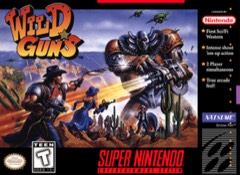
A shooting gallery set in a Wild West full of robots. Your gunslinger stands in the foreground and can sidestep, jump and roll; the enemies are in the town behind, firing back. Hold the button and the pad moves your crosshair instead of your feet, so you cannot run and shoot at once. Every second is a choice between aiming and dodging.
You play Annie, out to avenge her family against the Kid gang, or Clint, the space bounty hunter who tells her he works alone and loses the argument. Almost everything on screen can be shot, including enemy bullets. Hit enough of them and a gauge fills to give you a Vulcan gun and a few seconds of invincibility. Dynamite can be thrown back, a lasso stuns, and a 'Look Out!' bubble warns you when a bullet is coming close. Six levels, each ending in a boss, alone or with a friend.
Where it sits in history
Natsume made it quickly and cheaply while a small team waited for its next big job: Shunichi Taniguchi on design and graphics, Toshiyasu Miyabe on programming, Hiroyuki Iwatsuki on sound, plus two helpers, in about five months. The three had just made The Ninja Warriors on the Super NES. They borrowed from the arcade games Blood Bros. and Dynamite Duke, took the space-western look from the manga Cobra, and with no budget for actors, recorded Taniguchi's own voice for Clint in the office bathroom.
It came out in Japan on 12 August 1994. The American release, reviewed in 1994, slipped unexpectedly to 1995. The original cartridge is now a rare collector's item. It reached the Wii Virtual Console in 2010 and Nintendo Classics in 2020. The same team, now Tengo Project, made Wild Guns Reloaded with new characters and four-player play: PlayStation 4 in December 2016, Windows in July 2017 and Switch on 17 April 2018.
How it plays today
Brilliantly. The screen is packed with tiny animated detail, and the stop-to-aim rule makes it a game about rhythm: fire, holster, roll, fire again. It is hard even on easy, but every death is clearly your fault, and you get better fast.
With two players it is chaos in the best sense. It is short, which suits it: a run takes an evening, and you want another one the next night.
Compared with
- Ninja Warriors: The same small Natsume team, the same year, a beat 'em up instead of a shooter.
- Sunset Riders: Konami's Super NES western shooter, a year earlier.
- Hogan's Alley: The NES light-gun gallery, for a sense of how far the idea came in ten years.
Why it matters
Nobody planned Wild Guns as anyone's masterpiece. It was filler work for a team between projects, given almost no money and a few months. That is often how good play gets made: small, quick, with nothing to lose, the designer's voice echoing off bathroom tiles.
Huizinga saw play as free and set apart from ordinary life, with its own order. The team got a little of that freedom at work, and the game carries it. You can feel people enjoying themselves in it.
Read: The magic circle: the world that rules make →
- Huizinga, J. (1938/1949). Homo Ludens: A Study of the Play-Element in Culture.
What you're levelling up
You have been training these without noticing. Here is how to do it on purpose, and where it pays off away from the couch. All the skills games teach →
Judging risk
In the game. Hold the button and the pad moves your crosshair, not your feet, so you can't run and shoot at once. Every second is aim or dodge.
Do it on purpose. For one stage, count your shots before each roll. Try two, then three, then four, and note which number gets you hit least.
Off the couch. You can't do everything at once. Picking aim or dodge, study or work, save or spend, is the call that matters.
Timing and rhythm
In the game. Fire, holster, roll, fire again. The stop-to-aim rule turns the whole game into rhythm.
Do it on purpose. Play a level saying the rhythm under your breath: fire, fire, roll. Notice the moment you drop the beat and get hit.
Off the couch. Conversation has a rhythm too: listen, answer, pause. People who have it make a first date feel easy.
Bouncing back
In the game. It's hard even on easy, but every death is clearly your fault and you get better fast. A run takes an evening, and you want another the next night.
Do it on purpose. After each death, name the shot that got you. Next run, watch for that one first.
Off the couch. Fair failure is the best teacher. Owning a mistake at work, plainly, is how people learn to trust you.
Verdict · 9/10
A core team of three, five months and a bathroom microphone made one of the best shooters on the Super NES. Play it with a friend.