What it was
Jennifer Simpson is an orphan from Norway, newly adopted with three other girls by a rich recluse named Simon Barrows. His home is a mansion everyone calls the Clock Tower. Soon after they arrive, Mary, the woman who brought them, goes to find Mr Barrows and doesn't come back. The lights go out, a girl is dead, and Jennifer is being hunted by Bobby Barrows: a deformed little boy with an enormous pair of scissors. The Scissorman.
You never steer Jennifer directly. You move a cursor and click: walk here, open that, look at this. She can run, but running drains her stamina, and the only way to get it back is to sit on the floor and catch her breath while her portrait in the corner shows how she's holding up. When Scissorman finds you, the game drops into panic mode. There is no weapon. You hide, you spring a trap the house has left lying around, or you hammer a button to wrench free. Nine endings hang on what you find and what you do, and the items move between playthroughs.
Where it sits in history
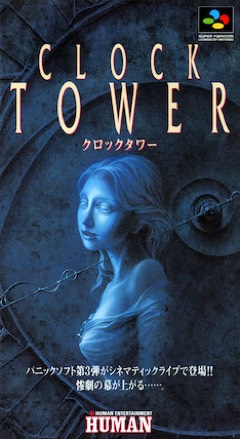
Human Entertainment released it on the Super Famicom on 14 September 1995, in Japan only. Director Hifumi Kono made it as a tribute to Dario Argento, above all his 1985 film Phenomena, and borrowed its occult mood and its young heroine in danger. Jennifer herself is modelled on Jennifer Connelly's role in that film. The cast were digitised from photos of real people, and Jennifer's stumbles and roof-hangs were acted out by a woman from Human's planning division.
It was a small, experimental project. Kono's colleagues doubted a game about running away could work, and a thin team meant no mouse support and a shrunken map. By Kono's account it sold fairly well anyway. A reworked version, Clock Tower: The First Fear, came to PlayStation, Windows and WonderSwan in 1997 with a dagger, an extra room and full-motion video. Apart from fan translations, the game stayed in Japan until WayForward and Limited Run Games released Clock Tower: Rewind on 29 October 2024 for Switch, PlayStation 4 and 5, Xbox Series X/S and Windows.
How it plays today
The atmosphere is still the whole show. Long stretches of quiet, then a jolt, and he's there. Scissorman doesn't need to be on screen to be in the room; you spend every calm moment waiting for him. Taking away the weapon is the masterstroke. Nothing in a gun-toting horror game feels as raw as crouching in a hiding spot with your stamina in the red, hoping the house is on your side.
The rest has aged harder. The mansion is laid out in 3D but drawn flat, so working out which door leads where is a chore, and much of the game is hunting for odds and ends to solve puzzles that turn out to be simple. One slip can end the run. Pushing a cursor around with a d-pad feels like steering a shopping trolley. Bring patience, or a map, and it pays you back in dread.
Compared with
- Sweet Home: The Famicom's earlier haunted-house horror, and a good way to see how far Clock Tower strips things back: one girl, no weapon.
- Laplace no Ma: Another Human Entertainment horror game, and one of the titles that, with Clock Tower, made the studio's name.
- Maniac Mansion: Point and click through a creepy family's mansion, played for laughs instead of screams.
Why it matters
Kono's colleagues thought a game about running away would never work. Who chooses to be powerless? Nearly everyone, it turns out, who has ever switched the lights off for a horror film. The philosopher Bernard Suits called playing a game 'the voluntary attempt to overcome unnecessary obstacles', and Clock Tower pushes that further than most: the obstacle is your own helplessness, and you sign up for it.
Jesper Juul calls it the paradox of failure. We dodge failing in everyday life, then go looking for it in games, because each failure makes us rethink and get better. Every time Scissorman catches Jennifer, you learn something: a hiding spot, a trap, a door not to open. Fear that teaches you is a strange gift, and a good one. Played on a couch with a mate clutching a cushion beside you, it's the safest way there is to practise being scared, and to find out you can keep going.
Read: One must imagine Mario happy →
- Suits, B. (1978). The Grasshopper: Games, Life and Utopia.
- Juul, J. (2013). The Art of Failure: An Essay on the Pain of Playing Video Games. MIT Press.
What you're levelling up
You have been training these without noticing. Here is how to do it on purpose, and where it pays off away from the couch. All the skills games teach →
Keeping your cool
In the game. When Scissorman finds you, the game flips into panic mode. No weapon, just a hiding spot, a trap, or mashing a button to wrench free.
Do it on purpose. Next time he shows up, take one breath before you click. Pick your hiding spot on purpose instead of bolting for the nearest door.
Off the couch. First date, spilled drink, awkward silence. Breathe, laugh it off, carry on. Staying easy when things go a bit wrong makes you good company.
Judging risk
In the game. Running gets Jennifer away but drains her stamina, and the only fix is sitting on the floor. Her portrait in the corner shows what's left in the tank.
Do it on purpose. Only sprint with a reason. Before you run, check the portrait and decide where you'll rest.
Off the couch. Energy is a budget. Big week at work, gym every day, out every night? Something gives. Spend it where it counts.
Spatial thinking
In the game. The mansion is designed in 3D but drawn in 2D, so you build the real layout in your head. The items move every playthrough, so the map is all you keep.
Do it on purpose. Sketch the mansion on paper as you go: every room, door and hiding spot. When he turns up, you'll already know where to run.
Off the couch. Knowing your exits works everywhere: a new office, a festival crowd, a city you've never been to. Learn the way back and you'll never feel lost.
Verdict · 7/10
A survival horror pioneer that still gets under your skin the moment Scissorman appears. The item hunting and clumsy navigation test your patience, but the dread is worth it.