What it was
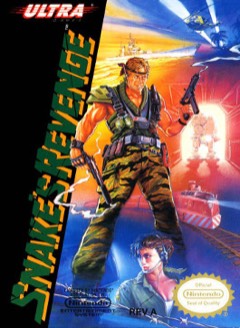
You are Solid Snake, creeping into an enemy base with a knife, a handgun and a bad feeling. Guards patrol the screens, and a single red exclamation mark over a head means you've been seen. Two marks means they're coming. Sometimes you can step into the next room and the problem forgets you.
It plays like the first Metal Gear with the edges knocked off. You start armed, and the knife kills a guard outright if you get close enough. Punch a guard out instead and he may leave a ration or an ammo box. Prisoners to free and officers to question with truth gas earn promotions, and rank decides how much you can carry. Every so often the view flips to the side, and Snake crawls and jumps through jungle and flooded tunnels like he's wandered into a different game. He has, a bit. The sections are in the spirit of Rush'n Attack.
Where it sits in history
Konami made it in 1990 as a stand-alone sequel for the West, after the NES version of Metal Gear did well overseas. Ultra Games published it in North America. Europe got it too. A team at Konami in Kobe built it, including lead programmer Hitoshi Akamatsu, who had also worked on Castlevania III: Dracula's Curse.
Hideo Kojima, who designed the original Metal Gear, wasn't in the room. By his account, one of the developers told him about the project. That nudged Kojima into making a true sequel with his own team, Metal Gear 2: Solid Snake for the MSX2, released in Japan the same year. Japan got his game, and the West got this one. There was no Famicom version of Snake's Revenge.
Kojima has been of two minds about it. He told Steven Kent in 1999 that he enjoyed it and found it faithful to the Metal Gear idea. At the 2009 Game Developers Conference he joked that it was somewhat of a crappy game, and later told Nintendo Power he doesn't think it's a bad one.
How it plays today
Some of it is clumsy. The alert phase asks you to beat a set number of soldiers before you can get back to sneaking, which turns tension into a chore, and the transceiver goes dead as soon as you're spotted. The side-view stretches are a fair swap of pace but not a clever one.
The good bits are the fiddly ones. Your three contacts, John, Nick and Jennifer, each have a use, and the plot gets a proper turn: Nick falls, Jennifer's cover as your agent inside is blown, and the commander turns out to be a cybernetic Big Boss. For a cartridge from 1990 that's a big swing, and the knife kill never stops feeling good.
Compared with
Why it matters
Snake's Revenge is a game about whose character Snake is. For years the West knew the sequel to Metal Gear as this one, and Japan knew a different one. Two teams, two games, one soldier. Players only had the cartridge they were handed, and it was the real thing to them.
James Paul Gee describes a projective identity: a blend of who you are and the character you're playing, shaped by what you want that character to be. That's what happens here. The Snake you carried out of that jungle was yours, whoever held the pen. Kojima's shifting view, a crappy game on one stage and not a bad game in print, is a nice reminder that the maker doesn't get the last word on what a game was for the people who played it.
Read: Who you are when you play →
- Gee, J. P. (2003). What Video Games Have to Teach Us About Learning and Literacy.
What you're levelling up
You have been training these without noticing. Here is how to do it on purpose, and where it pays off away from the couch. All the skills games teach →
Keeping your cool
In the game. One exclamation mark means a guard has seen you, and two means the alert phase starts. Freezing on the first is how it turns into the second.
Do it on purpose. Next time a guard spots you, walk into the next screen calmly instead of fighting, and see if the guard forgets you.
Off the couch. Not escalating a little problem into a big one just because your heart's going.
Planning ahead
In the game. Your rank sets what you can carry, so every ration, explosive and ammo box is a choice before you head into the next area.
Do it on purpose. Before each area, say out loud what you'll use and what you'll leave behind.
Off the couch. Packing for a weekend away so you aren't buying a charger at an airport.
Reading people
In the game. Officers can be questioned with truth gas, and deep in the base you meet a John who isn't John: an impostor wearing your teammate's face.
Do it on purpose. Notice who in the game gives you something and whose story changes later.
Off the couch. Spotting when a mate's story doesn't quite add up, without making a scene of it.
Verdict · 6/10
A scrappy cousin of the real thing, with good ideas and some chores. Play it for the story of why it exists, and for the bit where Big Boss comes back.