What it was
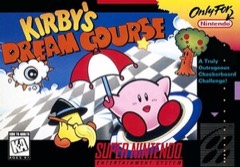
Mini golf seen from an angle, like Marble Madness, with Kirby as the ball. You set power, angle and spin, and send him rolling across the course to bump into enemies. Each one he hits becomes a star; when only one enemy is left, it turns into the hole. Fewer strokes, better medal.
Knock into the right enemy and Kirby copies its power: a tornado, a sparking ball that breaks blocks, a UFO you can steer for a few seconds. There are eight courses of eight holes for one player. Two players take turns on special two-player courses, stealing each other's stars by rolling over them, and the hole is worth two stars.
Where it sits in history
HAL Laboratory began it in 1992 as Special Tee Shot, a golf game with its own original characters. It was previewed in magazines and even pictured on the SNES box, then shelved after Kirby took off on the Game Boy. HAL reworked it into a Kirby game, adding copy abilities to fit, and Nintendo released it in Japan on 21 September 1994 and in North America in February 1995. It was the first Kirby game on the SNES. Special Tee Shot itself came out later, in 1996, through the Satellaview satellite service in Japan.
The second player is Keeby, a yellow Kirby. While making Kirby's Dream Land, Shigeru Miyamoto had assumed Kirby was yellow, because no colour art existed yet; Dream Course's team turned his guess into player two. Since Kirby 64 in 2000, yellow has been the usual colour for an extra Kirby in Kirby and Super Smash Bros. games. A Nintendo 64 sequel was shown in 1995 and never finished.
How it plays today
It still feels like nothing else. Working out a shot that caroms off a wall, flattens two enemies and leaves the last one where the new hole will be easy is a real puzzle, and the silliness never gets in the way of how clever the courses are. It is calm, too, a good game for a slow evening.
The controls ask for practice. Reviewers at the time noted that shots can feel less precise than they should, and later courses get hard. Stick with the first few and the system clicks. Two players taking stars off each other is where it shines.
Compared with
- Marble Madness: The isometric rolling-ball game Dream Course's angle recalls, with far less mercy.
- Kirby's Avalanche: The other SNES Kirby spin-off, a puzzle game that borrows Dream Course's music.
- Kirby's Dream Land 3: Kirby in his usual role, on the same console.
Why it matters
Dream Course takes golf, a game of quiet rules, and lets Kirby break most of them. Roger Caillois described play as a spectrum from paidia, free and messy improvising, to ludus, rule-bound play that rewards effort. Dream Course sits in the middle on purpose: strict about strokes and holes, loose about everything else.
Keeby is a small lesson too. A wrong guess from the most famous designer in the field became a colour, then a tradition players carry decades later. Play is where a slip gets to stay and become something.
Read: The magic circle: the world that rules make →
- Caillois, R. (1958/1961). Man, Play and Games (trans. M. Barash).
What you're levelling up
You have been training these without noticing. Here is how to do it on purpose, and where it pays off away from the couch. All the skills games teach →
Spatial thinking
In the game. Working out a shot that caroms off a wall, flattens two enemies and leaves the last one where the hole will be easy is a geometry puzzle at an angle.
Do it on purpose. Before each shot, trace the path with your finger on the screen. Afterwards, check where Kirby actually went.
Off the couch. Parking, packing a ute, moving a couch through a doorway. Picturing the angle first saves you three goes.
Planning ahead
In the game. When only one enemy is left it turns into the hole, so you're choosing which enemy you leave last. Plan it badly and the hole lands somewhere awful.
Do it on purpose. On every hole, decide which enemy you want as the last one before your first stroke. See how often you pull it off.
Off the couch. Thinking about where you'll be after the next move, not just this one, is how good managers and good mates operate. Rent, career, weekends.
Judging risk
In the game. You set power, angle and spin, and a big shot can clear two enemies or leave Kirby stranded. Fewer strokes means a better medal.
Do it on purpose. For one course, play every hole the safe way and then replay it chasing the big shot. Compare the scores.
Off the couch. Asking someone out is a risk worth taking more often than you reckon. Know the downside: a polite no, which you'll survive.
Verdict · 8/10
A golf game for people who do not like golf, built on bumpers, enemies and a pink ball with powers. Clever, gentle and still unlike anything else.