What it was
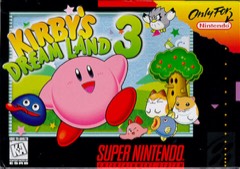
Kirby is fishing with his friend Gooey when a dark cloud spreads over Planet Popstar, and the two set out to stop it. You walk, swim, float and inhale enemies to copy their powers, as in every Kirby game. Gooey, a blue blob with a long tongue, can be called in at any time for two hit points, played by the computer or by a second player.
Six animal friends change how Kirby moves and how each power works: Rick the hamster climbs walls and grips the ice, Coo the owl flies into the wind, Kine the sunfish swims against currents, Nago the cat triple-jumps, Pitch the bird gets the most varied powers, and ChuChu the octopus clings to ceilings. Each level hides a Heart Star, usually won by solving a small puzzle with the right friend and power. Collect them all and the game opens a second, true ending.
Where it sits in history
HAL Laboratory made it and Nintendo published it in North America in November 1997, ahead of Japan in 1998. It was the last SNES game Nintendo published in North America. The cartridge carries an SA-1 coprocessor, and the art uses an SNES mode that blends neighbouring pixels to soften its dithered, pencil-drawn look.
Problems with the PAL conversion kept it out of Europe and Australia for years; players there first got it on the Wii Virtual Console in 2009, as an import of the American version. Reviews were mixed: some found it too easy, others loved its style. The secret final boss, Zero, a giant eye that bleeds at Kirby, is remembered as a rare burst of graphic violence in a first-party Nintendo game.
How it plays today
It looks like a picture book and sounds like a lullaby. The stages are short and gentle, and the animal friends are a joy to try out with each power. It is one of the best games on the SNES to share with a young child, because Gooey can drift along beside Kirby and never hold the game back.
The cost is speed. Kirby moves slowly, the combat is soft, and the Heart Star puzzles range from charming to obscure. Coming straight from Kirby Super Star, it feels small. But hunt every Heart Star and the last stretch is a different game, harder and stranger than its cover suggests.
Compared with
Why it matters
Dream Land 3 is built around friends. Kirby is never really alone: there is Gooey beside him, an animal under him, and a Heart Star that is usually won by helping someone else, carrying a friend's pet back to them or watering their flowers.
Ryan, Rigby and Przybylski found that games feel good when they meet our need for relatedness as well as competence and choice. Dream Land 3 leans hard on the first one, and it makes the game a natural first co-op for a parent and child, one leading and one tagging along, both with a real part to play.
Read: The second controller →
- Ryan, R. M., Rigby, C. S., & Przybylski, A. (2006). The motivational pull of video games: A self-determination theory approach. Motivation and Emotion, 30(4), 344-360. doi:10.1007/s11031-006-9051-8
What you're levelling up
You have been training these without noticing. Here is how to do it on purpose, and where it pays off away from the couch. All the skills games teach →
Problem solving
In the game. Each level hides a Heart Star, usually won by solving a small puzzle with the right animal friend and power. Some are charming, some are obscure.
Do it on purpose. When a Heart Star stumps you, list which friend and power combos you haven't tried in that room before reaching for a guide.
Off the couch. Most work problems have a few obvious options nobody bothered to test. Run through them before calling it impossible.
Teamwork
In the game. Gooey can be played by a second player and drift beside Kirby without ever holding the game back. It's one of the best SNES games to share with a young child.
Do it on purpose. Play with a little one and let them take the lead for a whole level. Your job is support, not steering.
Off the couch. Letting someone else lead and backing them up is a rare skill. Good partners, mates and teammates all know when to step back.
Curiosity
In the game. Six animal friends each change how every power works. Rick climbs walls, Coo flies into the wind, ChuChu clings to ceilings.
Do it on purpose. Pick one power and try it with all six friends. Write down the one combo that surprised you.
Off the couch. Asking 'what happens if' keeps you interesting. On a date, real curiosity about the other person's world beats rehearsed lines every time.
Verdict · 7/10
Gentle, beautiful and slow, with a final secret that makes the long hunt worth it. A lovely game to play with someone small.