What it was
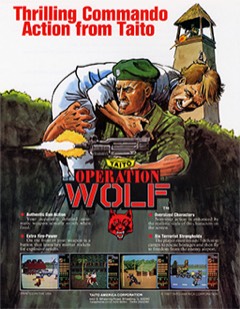
You're Roy Adams, a Special Forces operative sent behind enemy lines to rescue five hostages. The screen scrolls sideways, you aim a crosshair at everything that moves, and a counter tells you how many soldiers and vehicles you've got to drop before the stage ends. Trucks, boats, helicopters and armoured transports all want you dead, and so do the blokes with knives.
Taito made the arcade original in 1987, with a cabinet built around a mounted, Uzi-shaped gun that kicked back when you fired. The NES port came out in Japan in March 1989, in North America that May and in the PAL regions in 1992, with Daiei Seisakusho as developer and Taito publishing. Most home versions of the game made do with a keyboard or a pad. The NES and Master System ones are the exceptions, because they support a light gun.
Where it sits in history
Light gun games before this were shooting galleries and cartoons. Duck Hunt in 1984 is the famous one. Operation Wolf swapped the ducks for a war-film rescue mission, borrowing from action films and run-and-gun games, and it was a hit. It was one of the highest-grossing arcade games of 1988, second in Japan behind After Burner and top of the UK chart for the year, and it won a Golden Joystick Award for Game of the Year.
It also copped criticism. The violence was a target in the UK press, because the Hungerford massacre had happened only months before it landed. The imitators arrived anyway: Line of Fire, Beast Busters, Lethal Enforcers and others. The NES version didn't set the world alight. Three Electronic Gaming Monthly critics gave it a 6 out of 10 and one gave it an 8.
How it plays today
The loop is clear and the pressure is constant. Shoot the soldiers, shoot the rockets coming at you, grab the ammo and health pickups, and try not to hit a nurse. Mistakes cost you, because the damage bar fills when you shoot friendlies as well as when you get hit. Dynamite is the tricky one: it clears the screen, but it clears the friendlies too.
The NES version has more than one ending depending on how many hostages you rescue, which is a nice reason to go back and do better. With a Zapper and a CRT it's the proper experience. With a pad, expect to fight the crosshair a bit.
Compared with
- Operation Thunderbolt: The 1988 sequel in the same series, arriving the year after the original.
- Duck Hunt: Nintendo's 1984 light gun game, from the carnival-and-cartoon era Operation Wolf moved the genre on from.
- Hogan's Alley: A Nintendo Zapper shooter from the same console, if you want more of the same.
Why it matters
A good arcade game gives you a clear goal, quick feedback on every shot, and a challenge that sits close to your skill. That is how Mihaly Csikszentmihalyi described flow: you stop watching yourself and get absorbed in the task. Operation Wolf manages it by being simple. Aim, fire, reload, don't hit the nurse.
It is also a game about telling targets from people, and noticing what a miss costs. That's what lifts it above a plain shooting gallery.
Read: The zone: why good games make time disappear →
- Csikszentmihalyi, M. (1990). Flow: The Psychology of Optimal Experience.
What you're levelling up
You have been training these without noticing. Here is how to do it on purpose, and where it pays off away from the couch. All the skills games teach →
Hand-eye coordination
In the game. You swing a crosshair at soldiers, trucks and helicopters, and shoot incoming rockets and grenades out of the air before they land.
Do it on purpose. Play a stage and try to shoot every incoming projectile before it hits you.
Off the couch. Catching a falling glass, a quick text while walking, parking in a tight spot. Hand and eye working as one.
Judging risk
In the game. Dynamite wipes out every target on screen, enemy and friendly, so grabbing it is a bet.
Do it on purpose. Save the dynamite for the moment the screen is most crowded, not the first time you're nervous.
Off the couch. Knowing when a big move is worth the collateral. Money, mates, and the odd bad idea.
Keeping your cool
In the game. Enemies come from every direction and your damage bar fills as you take hits, so panic costs hostages.
Do it on purpose. Take one deep breath between waves and aim the next shot, not the last.
Off the couch. A packed pub on a Friday, a tricky conversation, a tight deadline. Staying level while it gets noisy.
Verdict · 7/10
A tense, loud rescue mission that earned its place in light gun history. Best with a Zapper, a bit rough without one.