What it was
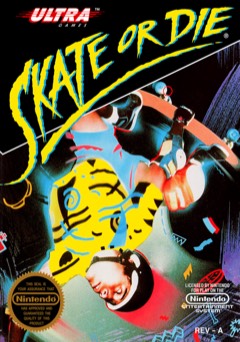
A skateboarding contest in five events, played one at a time or all in a row. Two are on a half-pipe: a freestyle ramp and a high jump. Two are downhill: a race through a park and a jam down a street. The fifth is the pool joust, a hand-to-hand knockout fight in an empty swimming pool.
It has a cast. Rodney Recloose, purple mohawk and Marine Corps tattoo, runs the skate shop. His son Bionic Lester, green flat-top, is even wilder and waits for you in the joust and the downhill jam. Poseur Pete takes on beginners, Aggro Eddie the middling, and Lester saves himself for the pros. The ramps are scored on points; the joust, the jam and the two-player race are head to head. In a full run of events, up to eight people can sign up.
Where it sits in history
Electronic Arts released it for the Commodore 64 in 1987, the first game EA made itself. Trip Hawkins wanted something to match Epyx's multi-event sports games, and hired Epyx programmers and artists who had just quit. Producer Don Traeger took the skateboarding idea from Atari's arcade game 720°, and Rob Hubbard came over from England to write the title music.
Konami ported it to the NES under its Ultra Games label in December 1988, with Kouji Murata arranging Hubbard's tune for the console's sound chip. That version sold 1.2 million copies by 1990. Ski or Die followed in 1990, and a true sequel, Skate or Die 2, the same year on the NES. Criterion started a remake in 2002 and EA cancelled it a year later for Burnout 3. The NES game reached the Virtual Console in Europe and Australia in 2007.
How it plays today
Alone, it is thin. Five events go by fast, and the ramp scoring rewards learning button timings more than anything that looks like skating. The downhill race is the best solo event: you pick lines through the park and it feels quick.
With a friend it comes alive, and the joust is the reason. Two people, one empty pool, a short scrap that demands an instant rematch. The music is still a blast, too. Treat it as a party game with a skating theme and it holds up.
Compared with
Why it matters
A Computer Gaming World reviewer pitched it at teenage board freaks and at adults who did not want to risk life and limb. That second group is the interesting one. The game lets you be a skater, with the haircut and the attitude, without the broken wrist.
James Paul Gee calls that a projective identity: a blend of who you are and the character you are steering, shaped by who you want that character to be. Plenty of kids in 1988 were never going to drop into a real pool. On a Saturday afternoon with a friend and a joystick, they were the kid in the empty pool knocking Aggro Eddie off his board, and that counted.
Read: Who you are when you play →
- Gee, J. P. (2003). What Video Games Have to Teach Us About Learning and Literacy.
What you're levelling up
You have been training these without noticing. Here is how to do it on purpose, and where it pays off away from the couch. All the skills games teach →
Winning and losing well
In the game. The pool joust is two people, one empty pool, a short scrap that demands an instant rematch. Up to eight people can sign up for the full run.
Do it on purpose. Run a tournament with mates. Loser of each joust picks the next event, winner shuts up about it.
Off the couch. Being fun to compete against at a party, pool or footy is a big part of being good company. People remember a gracious winner.
Timing and rhythm
In the game. The ramp scoring rewards learning button timings more than anything else. Get the beat and the score climbs.
Do it on purpose. Pick the freestyle ramp and work on one trick until you land it every time. Then add another.
Off the couch. Getting the rhythm right shows up everywhere: surfing, dancing, telling a story at the pub.
Judging risk
In the game. The downhill race through the park is all about picking lines. Fast and dangerous, or slower and safe.
Do it on purpose. Race the park three times, each with a different line through the trickiest bit. Keep the fastest.
Off the couch. Picking your line, when to take a chance and when to play safe, matters with money, career moves and asking someone out.
Verdict · 7/10
Five events, one great one: the pool joust is worth the cartridge on its own. A party game more than a skating game, and better for it.