What it was
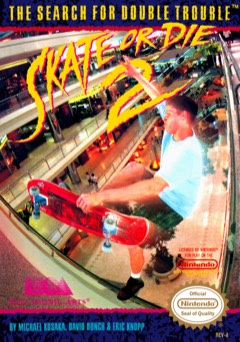
The sequel to Skate or Die! drops the contest format for a side-scrolling adventure on a skateboard, and you can roll back to areas you have already visited. The plot is gloriously daft. In the town of Elwood a thug called Icepick distracts the hero, who runs over the mayor's wife's poodle. She has her husband ban skateboarding. Then the local half-pipe is torn down because it never had a permit.
So you fix it. Four stages: the streets, where you face the mayor's wife; a two-floor shopping mall, where you work as a delivery boy against the clock for money; a beach, where you chase the blown-away pages of Rodney's half-pipe blueprints past roller skaters, crabs and body builders; and Icepick's four-floor warehouse, where your girlfriend CJ is held with the permit. Your weapons are a paintball gun, eggs and firecrackers.
Rodney and his son Lester come back from the first game. You trade them the CDs, cassettes, French fries and tacos you pick up for new boards and new tricks, and the button layout can be set by the player.
Where it sits in history
Electronic Arts made it and released it in North America in September 1990, only on the NES. The skater on the box is Jef Whitehead, later known as the sole member of the black metal project Leviathan.
At the end you get the reward: Double Trouble, a two-screen half-pipe with a spine ramp in the middle. You can also skip the whole story and skate it straight away by pressing Select on the title screen. You get three minutes and three wipe-outs; a hot streak makes CJ appear in a window and doubles your points for a while. A bad run ends with the hero smashing the board on his own head and saying 'No way, dude!'
How it plays today
The adventure is a curio more than a classic. It is easy to miss things, too: skip Rodney's boards or Lester's tricks in the first stage and neither turns up in the third. The mall deliveries are the most fun part, a frantic little job with shoppers and a security guard in the way.
Double Trouble is the reason to own it. Two screens of ramp, a timer and a score chase make it one of the best half-pipes on the NES, and being able to go straight to it from the title screen shows the designers knew it.
Compared with
- Skate or Die!: The first game, five contest events and the pool joust; better with friends.
- Paperboy: Another NES game about getting a job done on wheels while the street fights back.
- Ski or Die: The winter spin-off, back to contest events, with Rodney and Lester again.
Why it matters
The whole plot is about a rule. One accident and the town decides skaters are the problem, then a permit nobody had asked for makes their ramp illegal. Sociologists have a plain way of putting it: deviance is made by the rules groups create and by who those rules get applied to. As Howard Becker wrote, 'deviant behavior is behavior that people so label'.
The game's answer is paint first: pelt the mayor's wife, then get a job, buy the permit and build the ramp properly. It is silly, but it is also every kid who was moved on from a car park for skating, imagining the day the town finally gave them somewhere to go.
Read: The magic circle: the world that rules make →
- Becker, H. S. (1963). Outsiders: Studies in the Sociology of Deviance.
What you're levelling up
You have been training these without noticing. Here is how to do it on purpose, and where it pays off away from the couch. All the skills games teach →
Curiosity
In the game. Skip Rodney's boards or Lester's tricks in the first stage and neither turns up in the third. The game punishes rushing past things.
Do it on purpose. Clear the first stage slowly, finding Rodney and Lester and trading every CD and taco you pick up. See what it opens up later.
Off the couch. Asking about stuff and actually paying attention, at work or with someone new, opens doors that anyone in a hurry never sees.
Timing and rhythm
In the game. Double Trouble gives you three minutes and three wipe-outs on a two-screen half-pipe. Every trick lives or dies on when you press.
Do it on purpose. Do one run trying only one trick and land it five times clean. Then add the next.
Off the couch. Timing is everything in a good story or a good joke. Nail it and people lean in.
Problem solving
In the game. The plot is daft but the jobs are real: deliveries against the clock in the mall, chasing blueprint pages on the beach. Each stage is a different puzzle.
Do it on purpose. In the mall, plan your delivery route before you start. Time it, then try a different route.
Off the couch. Planning the fastest route for errands or a delivery job is the same brain. So is sorting a messy weekend with everyone's plans.
Verdict · 6/10
A goofy, overlong adventure wrapped around one excellent half-pipe. Press Select, skate Double Trouble, and keep the story for a rainy day.