What it was
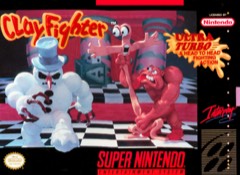
A meteor made entirely of clay crashes into a humble American circus. The goo gets into everything, and the circus's attractions turn into warped caricatures with new powers. Then they fight each other.
Meet the eight. Bad Mr. Frosty is a snowman with an attitude, the Blob morphs into objects to attack (a buzzsaw is his specialty), Blue Suede Goo is an Elvis impersonator who throws musical notes and uses his hair as a blade, and Bonker is a manic clown with a very large hammer. Helga is an opera singer in Viking dress, Ickybod Clay is a pumpkin-headed ghost, Taffy stretches himself into the longest-reaching moves in the game, and Tiny is a wrestler who barely wrestles.
The final boss is N. Boss, a string of pearls with two eyes, one wide open and one half closed. His name is a joke on M. Bison and the phrase end boss. He's the only one who isn't made of clay.
Where it sits in history
Visual Concepts developed it and Interplay published it, in November 1993 on the Super NES and in 1994 on the Genesis. Visual Concepts president Greg Thomas said the idea was a funny alternative to the violent but popular Street Fighter and Mortal Kombat. Interplay pitched it at parents who objected to blood-and-guts games.
The look came from real clay. Visual Concepts took the idea to animators Ken Pontac and David Bleiman at Danger Productions, and the two companies spent nearly a year on it. Artists moulded the characters in different poses and photographed them frame by frame, using different clays for different fighters: Taffy's was stronger than the Blob's. The Blob alone took about 70 models. A video camera linked to an Amiga digitised the figures.
Electronic Gaming Monthly named it the Best Street Fighter Wannabee of 1993, and also gave it Best Sound Effects and Best Ad. It sold 200,000 copies by 1994. Interplay followed it with ClayFighter: Tournament Edition in May 1994, first as a rental-only deal with Blockbuster Video in North America, which fixed many glitches and added modes.
How it plays today
The clay still looks terrific. Real models photographed one frame at a time have a texture that modern smoothness can't copy, and the animation has an odd, wobbly charm.
As a fighter it is simpler than the games it was mocking, and the humour carries more of the load than the combos do. Fine. It was never trying to out-Street-Fighter Street Fighter. It's the one you pull out when a mate who hates fighting games wants a go.
Compared with
Why it matters
ClayFighter is a game about not taking the serious thing too seriously. Mortal Kombat was ripping out spines in digitised gore, and this one answered with a snowman and a string of pearls. Laughing at the thing everybody is solemn about is its own kind of play.
Winnicott saw play as the space between the inner world and the outer one, where people are creative and find a self. A studio that decides its answer to a violent genre is a clown with a hammer is doing exactly that. The joke makes a statement about what they wanted games to be.
Read: Who you are when you play →
- Winnicott, D. W. (1971). Playing and Reality.
What you're levelling up
You have been training these without noticing. Here is how to do it on purpose, and where it pays off away from the couch. All the skills games teach →
Pattern recognition
In the game. Every fighter has a different style: Taffy reaches farther than anyone, Tiny charges across the screen with his fists, Ickybod Clay teleports. Learn the pattern and you can punish it.
Do it on purpose. Fight each of the eight on your own and write down the one thing each does too often.
Off the couch. Reading your opponent in tennis, spotting a mate's tell at poker night, or knowing which customer is about to be difficult.
Winning and losing well
In the game. It's a silly fighting game, so losing to a clown with a hammer is allowed to be funny. Keep it light and the next round is better.
Do it on purpose. Play a best of ten against a mate. The loser picks the next fighter for both of you.
Off the couch. Losing at darts, in the footy tipping, or at anything else with a grin and a handshake is a skill.
Making things
In the game. Artists moulded real clay figures and photographed each pose; the Blob alone needed about 70 models. Someone made all of that by hand.
Do it on purpose. Make a tiny character from plasticine or paper and give it three poses. See how many you need to make it feel alive.
Off the couch. Making something with your hands gives you a story. Nobody forgets the person who built a clay monster.
Verdict · 7/10
Not a deep fighter, but the funniest-looking one on the SNES, and still a great way to lose to your mate.