What it was
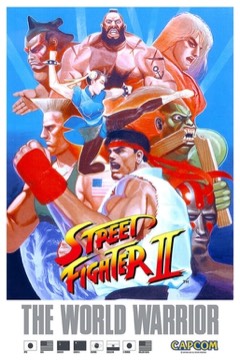
Eight fighters from around the world, each with a style of their own: Ryu and Ken's fireballs, Chun-Li's kicks, Guile's sonic boom, Blanka's electricity, E. Honda, Zangief and Dhalsim. Beat the other seven, then four bosses, and the tournament is yours. Special moves come from motions on the pad, not a button marked special, and six attack buttons split punches and kicks into light, medium and heavy.
In two-player mode the arcade rule held: two players could not pick the same fighter. The Super Famicom port added a secret code that allows a mirror match, with the second player in an alternate colour. The four bosses stay off the select screen.
Where it sits in history
Capcom's arcade original came out in 1991, designed by Akira Nishitani with characters by Akira Yasuda and Noritaka Funamizu producing, about two years and 35 to 40 people in the making. It became the highest-grossing arcade game in Japan that year and the next, and brought the arcades back to life.
The home port reached the Super Famicom on 10 June 1992, then North America and Europe later that year. It was the first game on a 16-megabit SNES cartridge, and plenty had to be trimmed to fit. Japan bought a million copies in its first two weeks. In the United Kingdom it replaced Super Mario World as the game packed with the SNES. Electronic Gaming Monthly named it Game of the Year for 1992, and it stayed Capcom's best-selling single game until Resident Evil 5 passed it in 2013.
How it plays today
The fighting itself is all there. The SNES pad has the six buttons the game needs, the characters are big and readable, and the moment two players learn each other's habits it becomes as tense as it ever was. Learning one character properly is still one of the best ways to spend a week with a SNES.
The problem is its own sequel. A year later Street Fighter II Turbo put this version and the faster Hyper Fighting on one cartridge, with the bosses playable and new special moves for several fighters. This one is slower and thinner by comparison. If you own both, you will play Turbo. If this is the one you find, it is still a proper Street Fighter II.
Compared with
Why it matters
Roger Caillois sorted play into four kinds, and the first is agon: competition, two people on even terms trying to find out who is better. Street Fighter II is agon stripped down. Same health bar, same timer, same three rounds; everything else is you. It is why the game made rivals out of friends in every lounge room it reached, and why, at its best, the rivalry stayed friendly.
Losing to someone at Street Fighter tells you exactly what they know that you don't. The fair fight is the gift. You go away, you practise the motion, you come back, and the next round is a conversation between two people who have both got a little better.
Read: The magic circle: the world that rules make →
- Caillois, R. (1958/1961). Man, Play and Games (trans. M. Barash).
What you're levelling up
You have been training these without noticing. Here is how to do it on purpose, and where it pays off away from the couch. All the skills games teach →
Reading people
In the game. The moment two players learn each other's habits, it gets as tense as it ever was. Every Guile has a favourite sonic boom pattern.
Do it on purpose. Play a mate for five rounds and write down their two most common openers. Next five, punish them.
Off the couch. Picking up on someone's habits, like a mate who goes quiet when stressed, lets you help before they ask. People feel seen.
Memory and routing
In the game. Special moves come from motions on the pad, not a button marked special. Learning one character properly is a week of muscle memory.
Do it on purpose. Pick one fighter and drill their three specials in training until you can do each ten times in a row.
Off the couch. Practising until something's automatic frees your head to think. Works for a guitar riff, a speech or a pitch at work.
Winning and losing well
In the game. Eight fighters, one couch, and two players who can't pick the same fighter without a secret code. Someone's losing and someone's gloating.
Do it on purpose. Shake hands after every set. Loser picks the next matchup, winner has to play a character they hate.
Off the couch. Being good company when you lose at anything, cards, sport, a work pitch, is rarer than winning. People notice.
Verdict · 8/10
The cartridge that brought the arcade's biggest game home and sold SNES consoles doing it. Superseded by Turbo, but the fighting is the real thing.