What it was
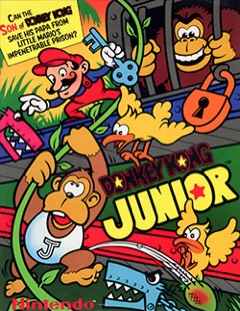
Mario has caged Donkey Kong, and the big ape's son wants him back. You are Junior: a small, determined ape who climbs vines and chains rather than ladders. Hold one vine and you climb slowly; grab two at once and you climb faster. You can slide down too. Snapjaws, bear traps with eyes, crawl along the vines after you. Nitpicker birds swoop and drop eggs. Sparks run along the wiring of Mario's hideout. Knock a piece of fruit off its vine and it falls through every enemy below it.
There are four stages. In the first three you reach the key beside your father's cage, and Mario wheels the cage away to the next screen. In the last you push six keys up into their locks to free him, and the pair walk off together while Mario takes a tumble. Then it all starts again, faster. A bonus timer counts down the whole time; let it hit zero and you lose a life.
Where it sits in history
Donkey Kong Jr. grew out of the scraps of Donkey Kong. Shigeru Miyamoto's team had made ideas and whole levels that did not fit the first game, and when Nintendo wanted another Donkey Kong arcade game, those ideas became this one. Miyamoto first wanted Donkey Kong himself as the hero, but he was too big to move around the screen, so the team gave him a son and put Mario in charge of the cage. Miyamoto designed it with Gunpei Yokoi; he drew the graphics with Yoshio Sakamoto, and Yukio Kaneoka wrote the music again.
It reached arcades in 1982 and was the eighth highest-grossing arcade game in Japan that year. The Famicom version was one of the console's three launch games in Japan in July 1983, and it came to the NES in North America in 1986. It also turned up on Atari, Coleco and Intellivision machines, Game & Watch handhelds, and in a 1988 NES compilation, Donkey Kong Classics. The game has a kill screen at level 22, and the high-score race has run for years: Justin Elliott set the record of 1,584,400 live on Twitch in July 2023.
How it plays today
It holds up better than its father. Vines give you a real choice that ladders never did, since one hand or two changes your speed, and the best runs come from switching vines at the last moment to slip past a Snapjaw. Dropping fruit onto a line of enemies is satisfying in a way the first game's hammer only hints at.
The NES version is the easy way in, and on Switch you can now play the arcade original too, through Arcade Archives, with both the Japanese and American stage orders. Either way it is a short game built for score-chasing. Ten minutes at a time is the right dose.
Compared with
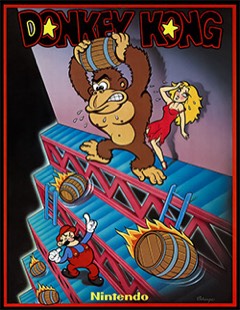
- Donkey Kong: The first game, with Mario as hero; ladders and barrels instead of vines and fruit.
- Donkey Kong 3: The third game, released in 1983, which took the series somewhere else again.
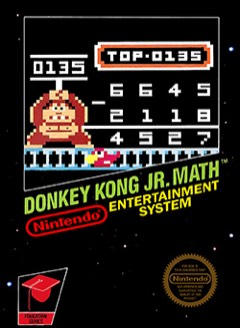
- Donkey Kong Jr. Math: An educational spin-off from the same year as Donkey Kong 3; a curio, not a sequel.
Why it matters
For one game, the hero is the bad guy. Junior wants exactly what every hero wants, to save someone he loves, and the person in his way is Mario. James Paul Gee describes a projective identity: the player and the character blend into someone new, shaped by what the player wants that character to be. Here the game asks you to want what Junior wants, and suddenly the plumber looks like a jailer.
That is a small, sharp lesson for a children's arcade game. Who counts as the villain depends on whose side of the cage you are standing on.
Read: Who you are when you play →
- Gee, J. P. (2003). What Video Games Have to Teach Us About Learning and Literacy.
What you're levelling up
You have been training these without noticing. Here is how to do it on purpose, and where it pays off away from the couch. All the skills games teach →
Judging risk
In the game. Hold one vine and climb slowly, grab two and climb faster. The best runs come from switching vines at the last moment to slip past a Snapjaw.
Do it on purpose. Play one run switching late every time, one switching early. Compare scores.
Off the couch. Waiting for the right moment versus playing safe: asking for the raise, asking someone out. Learn what a good risk feels like.
Timing and rhythm
In the game. Knock a piece of fruit off its vine and it falls through every enemy below it. Drop it at the right moment and you clear a line.
Do it on purpose. Wait for three enemies under a fruit before dropping it. Practise until you get it every time.
Off the couch. Good timing is patience plus nerve. Same thing makes you good at sport and at telling a joke.
Keeping your cool
In the game. A bonus timer counts down the whole time, and every loop runs faster. Rush it and you fall.
Do it on purpose. When the timer gets low, breathe out before the next grab. Don't panic-climb.
Off the couch. Deadlines, a running clock at an exam, a late train before a big night. Calm hands get there.
Verdict · 7/10
A sharper, more inventive game than Donkey Kong, and the rare time Nintendo let you chase Mario. Short, hard and built for high scores.