What it was
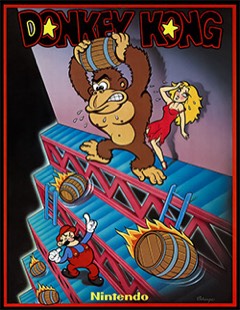
A gorilla has carried Pauline to the top of a construction site, and a carpenter then called Jumpman, later Mario, climbs after them. Donkey Kong rolls barrels down the sloping girders; you jump them, or grab a hammer and smash them for a few seconds of borrowed bravado. Next comes a stage of lifts and bouncing springs, then the top floor, where pulling out eight rivets drops the gorilla on his head.
Each screen is one height on the building: 25, 75 and 100 metres. The arcade had a fourth, the 50 metre cement factory with its conveyor belts, and the home version leaves it out. Clear the set and it starts again, faster and meaner.
Where it sits in history
The arcade game came out in 1981 because Nintendo needed it to. Radar Scope had flopped in America, and its unsold cabinets needed a new game inside them. Company president Hiroshi Yamauchi gave the job to Shigeru Miyamoto, who had never designed a video game, working with engineer Gunpei Yokoi. The result was the first platform game with jumping, and the first appearance of the character who became Mario.
When Nintendo built the Famicom, lead architect Masayuki Uemura designed it to recreate Donkey Kong faithfully. The port, by Nintendo Research & Development 2, launched with the console in Japan on 15 July 1983. In the West it joined the NES Arcade Classics Series in 1986. Early cartridges didn't have the memory for everything, so the cement factory and most of the cutscenes went, and Yukio Kaneoka wrote a new title-screen tune.
How it plays today
It is short and hard in the way arcade games are. Mario cannot fall far without dying, his jump is fixed once you commit, and learning the barrels' habits is where the skill lives. The hammer still feels great. The first time you clear the rivets and Donkey Kong crashes down, you understand how this filled arcades.
Missing the cement factory makes each loop feel a stage short, and after a few loops there is nothing new to see. Its value now is as a score chase and as history you can hold. If you want all four stages on a Nintendo console, the arcade original is the version to get.
Compared with
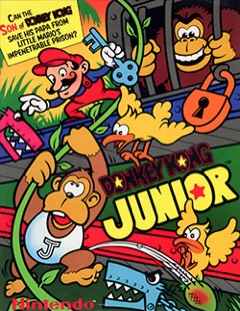
- Donkey Kong Jr.: The sequel flips the roles: you play the son, Mario is the villain, and there is more to climb.
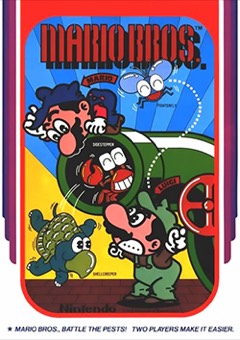
- Mario Bros.: Mario's next step, with Luigi and two players on one screen; more of a party game.
- Super Mario Bros.: Where the jump from Donkey Kong ends up: a whole world instead of four screens.
Why it matters
Nothing about Donkey Kong needs doing. The barrels would roll past if you stood aside, and Pauline is a few pixels in a dress. Bernard Suits defined playing a game as 'the voluntary attempt to overcome unnecessary obstacles', and this is that definition with a gorilla on top: a building you chose to climb, under rules you agreed to, for a score nobody asked for.
That choice is the whole point. People have spent decades on it, enough for a 2007 documentary, The King of Kong, about two men chasing its record. Strip the obstacles away and there is nothing left to want. Put them back and a man in overalls has somewhere to go.
Read: The magic circle: the world that rules make →
- Suits, B. (1978). The Grasshopper: Games, Life and Utopia.
What you're levelling up
You have been training these without noticing. Here is how to do it on purpose, and where it pays off away from the couch. All the skills games teach →
Pattern recognition
In the game. Learning the barrels' habits is where the skill lives. Mario's jump is fixed once you commit, so you need to know where they'll go.
Do it on purpose. Watch the barrels for thirty seconds without moving. Name which ladders they take down.
Off the couch. Most people's behaviour repeats. Spot the pattern, how your boss reacts to bad news, and you're ready for it.
Judging risk
In the game. Grab the hammer for a few seconds of borrowed bravado, or keep climbing. Mario can't fall far without dying.
Do it on purpose. Play one run never taking the hammer, one always taking it. Compare.
Off the couch. Borrowed confidence only lasts so long. Know the difference between a real edge and a lucky few seconds, in money and in life.
Memory and routing
In the game. Three screens, 25, 75 and 100 metres, and each loop faster. Score-chasing is all about knowing it cold.
Do it on purpose. Learn one screen well enough to play it on autopilot. Then work on the next.
Off the couch. Knowing your routine cold frees your head for the interesting stuff. Same with names: remember them and the conversation gets easier.
Verdict · 7/10
The game the Famicom was designed around, and the start of Mario. Lean, tough and a stage short; worth playing to know where it all came from.