What it was
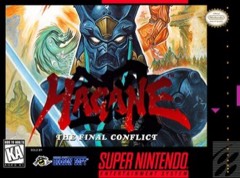
Hagane is a ninja who was nearly killed when the evil Koma clan raided his Fuma clan and stole the Holy Grail. A mysterious old man named Momochi saved his brain with cyber technology, and what's left is part man, part machine, and out for revenge.
It's a side-scrolling action platformer that mixes old Japan with a future setting. You carry four weapons and can swap between them: a sword, a chain, shuriken and grenades. There are limited magic attacks that clear the screen. Hagane somersaults, throws flying kicks, wall-jumps, slides and charges attacks.
He dies after three hits, though health power-ups can stretch the meter. When you die you lose the extra health. The stages are notably short and the checkpoints are few. There's no save feature, and in the Japanese version you can only continue up to seven times. One stage has you riding a hovercraft through a Mode 7 sequence.
Where it sits in history
CAProduction and Red Entertainment developed it and Hudson Soft published it. It came out in Japan on 18 November 1994, in Europe in May 1995 and in North America in June 1995. It arrived late in the 16-bit years, and that counted against it: GamePro held back from calling it a classic because the market was already moving on.
Nintendo Power compared it to the Ninja Gaiden series, praising the challenge, the non-stop action and the controls, while saying the graphics looked like a good NES game. GamePro's Lawrence Neves liked the controls and the variety of moves but found the music mundane, and called it worthwhile only as a rental. Next Generation noticed a resemblance to the Shinobi games on the Genesis. Total! ranked it 45th on its 1995 Top 100 SNES Games. Kurt Kalata of Hardcore Gaming 101 later called it a cult classic and sleeper hit, heavily influenced by Shinobi III, though he felt the level design didn't use the moves it gave you.
How it plays today
The moves are the draw: there are plenty of them, and learning to chain a wall jump into a sword swing feels good. The dark art is detailed, and the enemy sprites are the best part.
What lets it down is how the game uses its moves. Some platforming is frustrating, the environments are dark and a little bland and the music is forgettable. But if you like hard, old-school action, it's a cult game for good reason.
Compared with
- Ninja Gaiden II: The Dark Sword of Chaos: Tecmo's NES ninja, wall-clinging and brutal. Nintendo Power reached for Ninja Gaiden when it reviewed Hagane.
- Strider: Capcom's 1989 NES Strider: another hi-tech ninja in a dystopian future, but an action-adventure where Hagane is a straight-ahead fight.
- Contra III: The Alien Wars: Another SNES action game that asks you to learn a lot of moves under pressure.
Why it matters
Hagane asks you to learn, and a lot of it is learning to fail. Three hits, few checkpoints, no save. You come back because each death teaches you something.
Juul calls this the paradox of failure: we avoid failing in life yet look for it in games, because failure makes us reconsider and improve. Hagane is an unusually honest example. It doesn't soften the loss, so the improvement is yours.
Read: One must imagine Mario happy →
- Juul, J. (2013). The Art of Failure: An Essay on the Pain of Playing Video Games. MIT Press.
What you're levelling up
You have been training these without noticing. Here is how to do it on purpose, and where it pays off away from the couch. All the skills games teach →
Bouncing back
In the game. Three hits and Hagane is dead, and the extra health goes with him. Checkpoints are few, and there's no save.
Do it on purpose. After you die, restart immediately without a break. Aim to beat your previous attempt by one screen.
Off the couch. A knock-back at work, a flat tyre on the way to a date, a bad day. Get straight back up, aim one step further than last time, and the bad day stops being the story.
Hand-eye coordination
In the game. Wall jumps, slides, somersaults and flying kicks all have to be chained under pressure.
Do it on purpose. Spend five minutes just chaining wall jump to sword swing in a quiet stage until it's automatic.
Off the couch. Backyard cricket, a drum fill, catching the glass a mate knocks off the bar. Hands that follow your eyes look effortless, and effortless is a good look.
Judging risk
In the game. Limited magic attacks clear the screen, and there aren't many. You choose when to spend them.
Do it on purpose. Try a stage without using any screen-clearing magic until a boss. See how much you actually needed it.
Off the couch. Your best story, your savings, your one favour with the boss: you don't spend them on the first problem. Know what's in reserve and keep it for the boss fight.
Verdict · 7/10
A cult-classic action game with a great move set and some uneven level design. Best for people who like to be beaten and come back.