What it was
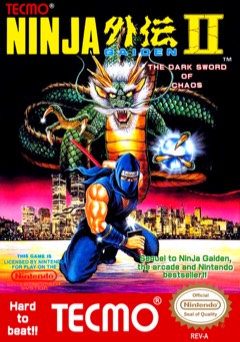
Ryu Hayabusa is back a year after the first game, running and leaping through levels called Acts with a sword, a strength meter, ninja power and a timer. Crystal balls hold power-ups: shuriken, a boomerang-like Windmill Throwing Star, fire wheels that fly up or down, and a ring of fire that kills on contact. Each Act ends in a boss.
Two changes make it feel new. Ryu can now climb up and down walls, and attack from them. And an orange ninja symbol splits his body: a shadow clone follows behind and copies every move, so a well-placed pair of clones can tear through enemies and bosses.
Between Acts, cinema scenes tell the story. An emperor named Ashtar plans to open the Gate of Darkness with the Dark Sword of Chaos; a U.S. Army agent, Robert T. Sturgeon, recruits Ryu; Irene Lew is kidnapped, then worse.
Where it sits in history
Tecmo developed and published it. Nintendo first showed it as a PlayChoice-10 arcade game in March 1990; the Famicom version came out in Japan on 6 April 1990, the NES in North America in May, and Europe waited until 27 October 1994, where it was called Shadow Warriors II.
Previews and reviews were glowing. Electronic Gaming Monthly made it Game of the Month and its reviewers called it one of the best sequels and best NES games; Nintendo Power nominated it for five awards. Reviewers agreed on better graphics and controls, and a story more predictable than the first game's. In 1997 Electronic Gaming Monthly called it easily the best of the NES trilogy. It has come back on the Virtual Console, on Nintendo Classics in November 2025, and in Hamster's Console Archives on Switch 2 and PlayStation 5 in February 2026.
How it plays today
Superbly. Wall-climbing removes the first game's most maddening deaths, and the clones turn fights into small puzzles of where to stand. The train stage still looks astonishing for the NES.
It is still very hard, especially once wind, rain and darkness lit only by lightning start shoving you off platforms, and the final bosses are cruel. Losing all your lives sends you back to the start of the level, not the game.
Compared with
Why it matters
Ninja Gaiden II kills you constantly, and people call it one of the best games of its era. Juul calls this the paradox of failure: we avoid failing in life but seek it in games, because failing makes us rethink and improve. Every death here teaches something precise, a jump timed early, a clone left in the wrong place.
Granic and colleagues' review of the evidence found play can build persistence after failure. A game this hard and this fair is that, in miniature: you lose, you learn, you go again.
Read: One must imagine Mario happy →
- Juul, J. (2013). The Art of Failure: An Essay on the Pain of Playing Video Games. MIT Press.
- Granic, I., Lobel, A., & Engels, R. C. M. E. (2014). The benefits of playing video games. American Psychologist, 69(1), 66-78. doi:10.1037/a0034857
What you're levelling up
You have been training these without noticing. Here is how to do it on purpose, and where it pays off away from the couch. All the skills games teach →
Spatial thinking
In the game. The shadow clones copy every move Ryu makes, so a well-placed pair turns fights into small puzzles of where to stand.
Do it on purpose. In one boss fight, plan where your clones will be before you move. Try two positions and see which hits harder.
Off the couch. Thinking about where things end up after you move is useful in sport, driving and rearranging a room.
Bouncing back
In the game. It's very hard, especially once wind, rain and darkness lit only by lightning shove you off platforms. Losing all your lives sends you back to the start of the level.
Do it on purpose. When an Act sends you back, set the goal of one screen further. Not a full clear.
Off the couch. Knocked back by a job application, or a date who never texted back? Small progress beats a huge goal you never hit. Go again with one thing better.
Hand-eye coordination
In the game. Ryu climbs up and down walls and attacks from them, and the wind stages shove you around while you're jumping.
Do it on purpose. Replay one windy section and count your clean jumps. Try to beat the number each attempt.
Off the couch. Steady hands under pressure help in sport, in the kitchen, and when you're carrying three beers through a crowd.
Verdict · 9/10
The best of the NES Ninja Gaidens: faster, fairer and more inventive than the first, and still a fight to the last screen. Bring patience.