What it was
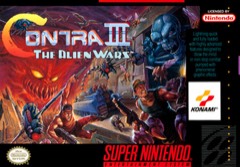
Aliens have invaded Earth, and two commandos, Bill Rizer and Lance Bean, are all that stand in the way. That is the brief, and the game spends almost no time on it. You run, jump, climb, and shoot everything across six stages, alone or with a friend.
Four stages scroll sideways in classic Contra style. The other two are overhead, drawn with the SNES's Mode 7 so the whole map rotates as you turn, while you hunt down a set of targets. You carry two guns and switch between them, each taking one power-up such as the spread shot, flamethrower, laser or homing missiles, plus a stock of screen-clearing bombs. Die and you lose the weapon you were holding.
Where it sits in history
Konami released it in Japan on 28 February 1992 and in North America on 26 March. Europe got it that September as Super Probotector: Alien Rebels, with the heroes redrawn as robots and a slightly slower frame rate on PAL machines.
It was the first Contra directed by Nobuya Nakazato, who went on to direct later entries. He thought the series needed more humour and more spectacle, and he set a rule that something interesting should happen every three screens of scrolling. That is why you end up hanging from a flying missile, and why mid-stage bosses turn up so often. The effect pushed the SNES hard; the missile scene is drawn partly with background tricks so the hardware could cope.
How it plays today
Brilliantly, if you like being tested. The action is dense, loud and inventive from the first screen, the bosses are huge, and the controls are sharp enough that every death is your fault. With two players it is chaotic in the best way. A run takes an evening, and learning it well takes many.
The overhead stages are the weak spot: turning the map is disorienting and they feel slow next to the side-scrolling ones. Losing your gun on death can leave you under-armed at the worst moment. The difficulty is steep on normal and brutal above it, and North American and European players get limited continues where the Japanese version is more forgiving. Shortness is the other honest complaint.
Compared with
- Contra: The NES original is simpler and fairer; Contra III is bigger, faster and more theatrical.
- Super C: The last NES entry before this one. Contra III keeps the formula and adds far more spectacle per screen.
- Super Castlevania IV: Konami's other big early SNES action game, slower and more measured, and just as hard to put down.
Why it matters
Contra III kills you constantly, and every death is your fault. The controls are sharp enough that you cannot blame the game. That should make it miserable. Somehow it makes it one of the best evenings the SNES offers.
Bernard Suits defined playing a game as 'the voluntary attempt to overcome unnecessary obstacles'. Nobody needs to hang off a flying missile while shooting aliens. We queue up for it. Jesper Juul calls this the paradox of failure: we avoid failure in life yet seek it in games, where it makes us reconsider and improve. Each death teaches you where a boss will strike next, and the lessons stack until a run you could not imagine becomes routine. With a second player it gets better, because you fail together, laugh at the same explosions and learn the same stage side by side. A shared defeat you can simply retry is a strangely warm thing.
Read: One must imagine Mario happy →
- Suits, B. (1978). The Grasshopper: Games, Life and Utopia.
- Juul, J. (2013). The Art of Failure: An Essay on the Pain of Playing Video Games. MIT Press.
What you're levelling up
You have been training these without noticing. Here is how to do it on purpose, and where it pays off away from the couch. All the skills games teach →
Keeping your cool
In the game. The action is dense and loud from the first screen, the bosses are huge, and the difficulty is brutal above normal. Every death is your fault, which is the point.
Do it on purpose. When the screen fills up, loosen your thumbs and pick one target. Don't spray. Count how often that keeps you alive.
Off the couch. Job interview, a big deadline, the moment a date goes quiet. Whoever stays level gets to think while everyone else flaps.
Judging risk
In the game. Two guns, and you lose the one you're holding when you die. Pick the wrong one to carry into a boss and you're under-armed at the worst moment.
Do it on purpose. Before each boss, say which gun you're holding and why. Swap on purpose, not by panic.
Off the couch. Don't put all your eggs in one basket, mate: savings, career, side gig. Know what you lose if it goes wrong.
Teamwork
In the game. With two players it's chaotic in the best way. Bill and Lance need to split the screen or they both die.
Do it on purpose. Play co-op and call every threat out loud. Decide who takes top and who takes bottom before each stage.
Off the couch. Every job's a co-op game. Calling your position and covering your mate is what makes you the one people want next to them.
Verdict · 9/10
The high point of Contra on Nintendo hardware and one of the best action games on the SNES. Short, hard and relentlessly entertaining.