What it was
Thomas walks into the Devil's Temple to get Sylvia back, and the temple is a straight line. Enemies come from both sides. Grippers grab and drain your energy until you shake them off, knife throwers aim high or low, and small Tom Toms dive at you. You punch, kick, crouch and jump, and every hit is a question of distance.
Each of the five floors ends with a boss who has an energy bar like yours, so the game turns into a one-on-one fight for a minute. There is a time limit on every floor. Beat Mr X at the top, rescue Sylvia, and it starts again, harder.
Where it sits in history
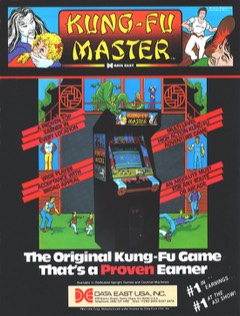
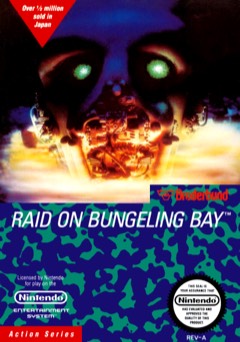
Irem's arcade original, Kung-Fu Master, was designed by Takashi Nishiyama and loosely based on Jackie Chan's Wheels on Meals, called Spartan X in Japan; Thomas is named after Chan's character. It was one of America's biggest arcade games of 1985. Nintendo converted it for the Famicom, released as Spartan X in June 1985 and as Kung Fu for the NES that year, with Shigeru Miyamoto directing and Koji Kondo on sound effects.
Miyamoto said building this port and Excitebike gave his team the know-how for Super Mario Bros.: long side-scrolling stages, with colourful backgrounds in place of black. Kung Fu sold 1.42 million copies in Japan and 3.5 million worldwide, and it was the best-selling game in the United States in July and again in September 1986. Akira Toriyama cited the Famicom version as an inspiration for the Muscle Tower arc in Dragon Ball. In 2017 IGN ranked it 62nd among the best NES games.
How it plays today
Still sharp. The controls are instant and the rhythm, step, crouch, kick, is easy to learn and hard to keep up when the grippers bunch up. The bosses make every floor end with a test.
It is short, and the second loop adds speed rather than ideas. IGN called it a dumbed-down port of the arcade game, and side by side the arcade is richer. On its own terms it is one of the best early NES games to pick up cold.
Compared with
- Double Dragon: A later beat 'em up, with room to move up and down the street.
- Super Mario Bros.: Built by the team that learned side-scrolling on this port.
- Trojan: Nishiyama's later Capcom game, which grew out of Kung-Fu Master's ideas.
- Spartan X 2: The Famicom sequel, which never came out in North America at the time.
Why it matters
Jesper Juul calls it the paradox of failure: we avoid failing in life, yet we seek it in games, because failing makes us look again and get better. Kung Fu is built on that loop. Run out of time on a floor and you play the whole floor again, and every time the grippers go down a little faster.
It worked on its makers too. Miyamoto's team ported someone else's game and came away knowing how to make Super Mario Bros. Sometimes the way to learn a craft is to rebuild someone else's work.
Read: One must imagine Mario happy →
- Juul, J. (2013). The Art of Failure: An Essay on the Pain of Playing Video Games. MIT Press.
What you're levelling up
You have been training these without noticing. Here is how to do it on purpose, and where it pays off away from the couch. All the skills games teach →
Timing and rhythm
In the game. Every hit is a question of distance. Step, crouch, kick, and grippers bunching up from both sides make the rhythm hard to keep.
Do it on purpose. Play floor one focused only on kicking each enemy at the very edge of your reach. Count how many grab you anyway.
Off the couch. Timing is when to tell the joke, when to ask for the raise, when to go in for the hug. Too early or too late both miss.
Pattern recognition
In the game. Knife throwers aim high or low, Tom Toms dive at you, and each floor's boss has a habit you can learn in a minute.
Do it on purpose. Fight one boss without attacking for ten seconds. Just watch what it does, then go in.
Off the couch. Your boss, your mates and your bank account all run patterns. Spot them and you stop getting caught out.
Bouncing back
In the game. Five floors, a time limit on each, and a second loop that's faster. Losing is quick, and so is starting again.
Do it on purpose. Set a goal of one floor further than last time, not a full clear. Celebrate the extra floor.
Off the couch. Getting knocked back at the gym or in a job hunt? Aim for one floor further, not the whole temple.
Verdict · 7/10
A tight, fast, five-floor fight that holds up better than most launch games. Its biggest legacy is the Mario game it taught Nintendo to make.