What it was
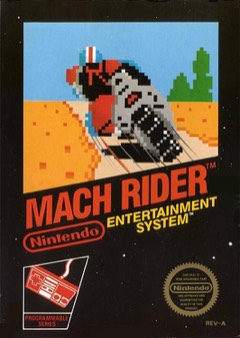
It is the year 2112 and raiders in vehicles called Quadrunners have overrun Earth. You ride a superbike from sector to sector looking for survivors, gunning down what gets in the way. Left and right steer, A accelerates, B fires the machine gun, and up and down shift through four gears. Hit fourth gear at speed and you get a sudden burst; stay in a high gear after stopping and you crawl away.
Ram an enemy into a roadside hazard and you score more and refill your bullets. Fighting Course is the story: ten sectors, each with a choice of Track A or Track B, then ten new sectors, then round again with no ending. Endurance Course is a race against the clock with enemies in the way, Solo Course the same with the road empty, and Design Mode lets you build your own sector to ride in any of them.
Where it sits in history
HAL Laboratory developed it and Nintendo published it. It reached the Famicom and Nintendo's VS. arcade system in Japan in 1985, the VS. system in North America the same year, the NES in North America in 1986, and Europe in 1987. The name was older than the game: in 1972 Nintendo sold a toy hot rod called Mach Rider, charged up in a launcher and fired off a ramp.
As with Excitebike, saving your own tracks needed the Famicom Data Recorder, a tape drive sold only in Japan, so Western players could build a sector but not keep it. The Wii and Wii U Virtual Console versions put the saving back. The arcade VS. Mach Rider is mostly the Endurance Course, revealing a picture of a woman with a dagger beside the bike piece by piece as you clear each level. The NES game joined Nintendo Classics on Switch in 2024.
How it plays today
Faster and harder than it looks. The gears matter: shifting well is the difference between threading the traffic and eating an oil drum. The forked tracks give the Fighting Course a reason to replay, and the endless loop suits short sessions.
The road is the same grey stripe through most sectors and the enemies blur together, so a long run gets repetitive. Design Mode adds variety: build a sector, then ride it.
Compared with
- Excitebike: The same era, the same tape-drive editor, and the better game.
- Rad Racer: A later NES racer that went for speed without the guns.
- Spy Hunter: The arcade drive-and-shoot game Mach Rider most resembles.
Why it matters
Csikszentmihalyi found that absorption comes when a challenge sits just at the edge of skill and the feedback is instant, and that time bends while it lasts. Mach Rider's gearbox is built for that edge. Shift too early and you lose speed, too late and you hit something, and the screen tells you which within a second.
With no ending, the game never asks you to stop. You ride sector after sector, the loop starts over, and you only notice how long it has been when you look up. That is the plain pull of flow: not a story or a reward, just a task the right size for your hands.
Read: The zone: why good games make time disappear →
- Csikszentmihalyi, M. (1990). Flow: The Psychology of Optimal Experience.
What you're levelling up
You have been training these without noticing. Here is how to do it on purpose, and where it pays off away from the couch. All the skills games teach →
Timing and rhythm
In the game. Hit fourth gear at speed and you get a sudden burst; stay in a high gear after stopping and you crawl. Shifting well is the difference between threading traffic and eating an oil drum.
Do it on purpose. Ride one sector paying attention only to your shifts. Say the gear out loud each change and feel where the burst kicks in.
Off the couch. Driving a manual, a golf swing, a pause before the punchline. Getting the beat right makes everything easier.
Hand-eye coordination
In the game. You're steering, shifting and gunning raiders all at once, and ramming them into roadside hazards to refill your bullets.
Do it on purpose. Try a Solo Course run with the road empty and just practise clean lines. Then go back to Fighting Course and see what stuck.
Off the couch. Doing three things with your hands at once is half of cooking a barbecue for twenty people. Look like you've got it handled and people relax.
Making things
In the game. Design Mode lets you build your own sector and ride it in any mode.
Do it on purpose. Build a sector that's hard but fair, then hand it to a mate and watch where they crash. Tweak it.
Off the couch. Making something and letting people test it is how products, gigs and side hustles get good. Feedback stings, then helps.
Verdict · 5/10
A gearbox, a gun and a road with no end. Rough, quick and better in short bursts than its reputation.