What it was
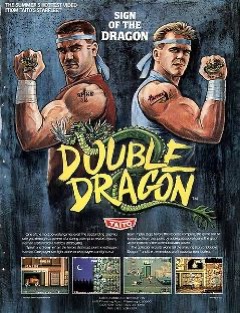
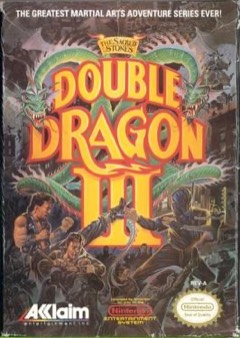
Billy Lee's girlfriend Marian is snatched by the Black Warriors gang, and he fights through a ruined city, a factory, a forest and the gang's hideout to get her back. Punch, kick, jump, elbow, throw; knock a bat or a whip out of someone's hand and it is yours. The arcade look came from Mad Max and Fist of the North Star, and the name from the two-player game and Enter the Dragon.
The NES version is its own animal. There is no co-op: two players take turns. So the story changed, and Billy's twin Jimmy becomes the gang's true leader and the final fight. You start with only basic attacks and earn experience for each enemy beaten, unlocking stronger moves as you climb up to seven experience levels. Stages were redrawn with more platforms and traps, and a new boss, Chin, joins the gang. On the side sits Mode B, a one-on-one fighter with bigger sprites, where you can pick Billy or one of five of his enemies.
Where it sits in history
Yoshihisa Kishimoto led the arcade game at Technōs Japan as a follow-up to his Nekketsu Kōha Kunio-kun, known in the West as Renegade. Taito released it in 1987, and it became America's highest-grossing arcade game of 1988 and its highest-grossing dedicated cabinet again in 1989. It set the template for the beat 'em ups that followed.
Technōs ported it to the Famicom in 1988. Tradewest published it in North America and Nintendo in Europe. It was only Technōs's second NES game, and the co-op mode was reportedly dropped because the programmers did not yet know the hardware well, which also explains its many bugs. None of that hurt sales: it sold out in its first two weeks in the US, topped the US charts by July 1988, and was one of the most wanted games of that Christmas, alongside Super Mario Bros. 2 and Zelda II.
How it plays today
The fighting feels good. Hits land with weight, the elbow strike is as handy as ever, and earning new moves gives the early stages a real sense of growth. The redesigned Mission 3 cavern, with its jumps and traps, is where the game stops being a brawler and becomes a test of your jumping.
The limits show. Only two enemies appear at once, always as an identical pair, weapons vanish when a wave is cleared, and the platforming can be cruel in a game built for punching. Above all, a game called Double Dragon without two players feels odd. Play it for the levelling and Mode B, then try Double Dragon II, which brought co-op to the NES.
Compared with
Why it matters
Double Dragon's name is about two people. In the arcade, one player grabs a thug from behind and the other lands the hits; at the end, the brothers turn on each other over Marian. The NES had to drop the friend, and so it turned the brother into the villain.
Goffman wrote that a game makes a shared little world, and that being absorbed in it together is what makes an encounter feel alive. Take the second player away and you can feel the gap. The NES game is still fun, but it shows by its absence what the arcade original was really selling: a reason to stand next to someone.
Read: The second controller →
- Goffman, E. (1961). Encounters: Two Studies in the Sociology of Interaction ('Fun in Games').
What you're levelling up
You have been training these without noticing. Here is how to do it on purpose, and where it pays off away from the couch. All the skills games teach →
Bouncing back
In the game. Billy starts weak, with only basic attacks, and early deaths come cheap. But every enemy you beat still banks experience toward stronger moves, so even a bad run leaves you better armed.
Do it on purpose. Write down each new move as you unlock it, and use it on purpose straight away.
Off the couch. Every new job starts with basics. Do them well, keep learning, and the moves come. Patience beats sulking.
Reading people
In the game. Mode B is a one-on-one fighter with bigger sprites. Pick Billy or one of five enemies and duel a mate.
Do it on purpose. Spend a round just watching your mate's habits in Mode B. Name them, then punish them.
Off the couch. Reading when someone's keen, bored or nervous is most of being good company. Most people are too busy talking. Watch first.
Keeping your cool
In the game. The Mission 3 cavern, with its jumps and traps, stops being a brawler and becomes a test of your jumping. The platforming can be cruel.
Do it on purpose. When you die in the cavern, wait five seconds before you continue. Loosen your grip.
Off the couch. Nobody fancies someone who throws the controller. Calm under a bit of pressure is quietly attractive.
Verdict · 7/10
A strong, strange port that swapped a friend for a level-up bar. Worth playing, and worth playing its sequel straight after.