What it was
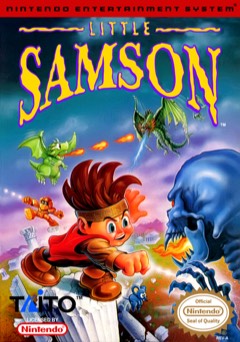
The demon king Ta-Keed has broken out of his mountain prison, and the emperor of Forgy summons four heroes who hold the bells of the gods. Samson is a boy who throws bells and climbs walls and ceilings. Kikira is a dragon who flies in short bursts and breathes fire you can charge up. Gamm is a slow stone golem who punches hard in any direction and walks on spikes. K.O. is a mouse with almost no health who squeezes through gaps, climbs walls and drops bombs.
The first four stages teach you one hero each, in any order you like. After that you can swap between all four at any moment, and the levels are built so you need to. Each hero has their own life bar but you share a pool of lives. If a friend falls they stay down until the stage ends or someone uses a potion on them. If Samson falls, you start the stage again.
Where it sits in history
Takeru, the studio behind Cocoron, made it, and Shinichi Yoshimoto directed, produced and wrote it after working as a designer at Capcom on Ghouls 'n Ghosts and Strider. Kiyoshi Utata did the art. Taito released it in Japan as Seirei Densetsu Lickle on 26 June 1992, in North America that November and in Europe in March 1993.
Reviews were good: Nintendo Power liked how swapping heroes added strategy to the action. Marketing was poor and sales in North America were low, and that is why it is now one of the rarest and most expensive NES cartridges. IGN, USgamer and Paste have all listed it among the best NES games. In 2025 Limited Run Games announced a re-release for Switch, PlayStation 5 and Steam in 2026, after tracking the rights down through Japan's Agency for Cultural Affairs.
How it plays today
It looks astonishing. The characters move with an ease and detail that most NES games never manage, and the bosses are big. The controls are tight, the four heroes feel genuinely different, and working out who to bring to which part of a level is the fun of it.
It also asks more than it explains. Losing Samson resets the stage even if the other three are fine. Play on Normal, not Easy: only Normal leads to the true final boss.
Compared with
- Mega Man: The series Little Samson is said to recall, with one hero where it has four.
- Strider: Director Shinichi Yoshimoto worked on Capcom's Strider as a designer before making this.
- Adventure Island: A simpler NES platformer, one hero, one way through.
Why it matters
Once the four heroes gather, Kikira the dragon refuses to follow Samson and fights him for the lead. She loses, and from then on the four of them are a team. The game then makes the team the point: the levels keep asking for someone other than the hero you're using.
Erving Goffman wrote that a game builds a small shared world with its own rules about what counts. Little Samson's rule is that weakness is a job description. The mouse with the least health is the only one who fits through the gap, and the game is better for every one of them.
Read: The second controller →
- Goffman, E. (1961). Encounters: Two Studies in the Sociology of Interaction ('Fun in Games').
What you're levelling up
You have been training these without noticing. Here is how to do it on purpose, and where it pays off away from the couch. All the skills games teach →
Teamwork
In the game. Four heroes, one pool of lives, and levels built so you need all of them. Gamm walks on spikes, K.O. squeezes through gaps, Kikira flies, Samson climbs ceilings.
Do it on purpose. On your next stage, swap to whoever the room actually needs instead of sticking with your favourite. Count how many swaps you made.
Off the couch. Good teams at work aren't four of the same person. Knowing who's good at what, and handing them the ball, is how a manager earns respect.
Judging risk
In the game. K.O. has almost no health, and if Samson falls the whole stage restarts, even if the other three are fine. Who you risk in a dangerous spot matters.
Do it on purpose. Before each tough section, decide who's expendable and who isn't. Keep Samson out of trouble for a whole stage and see the difference.
Off the couch. Know what you can afford to lose. In money, in a job, in a mate's trust. Protect the thing that resets everything.
Problem solving
In the game. Working out who to bring to which part of a level is the fun of it. The game asks more than it explains.
Do it on purpose. When a section stumps you, try it with each hero once before giving up. Write down which one cracked it.
Off the couch. Being the person who works it out quietly, without a manual, is attractive in a way nobody puts on a poster. Competence is good company.
Verdict · 9/10
One of the best-made games on the NES, ignored on release and priced out of reach since. Worth every bit of the fuss.