What it was
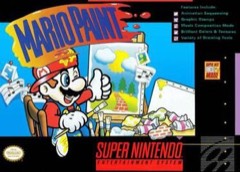
Not really a game. Mario Paint is a box of tools: a drawing board, a colouring book, an animation maker called Animation Land and a music composer, all driven by the Super NES Mouse it came packed with. Everything wears Mario's clothes, with sprites and sounds in the style of Super Mario World.
The drawing board gives you 15 colours, 75 patterns, pens, an airbrush, fill, shapes, copy and paste, and 120 stamps plus a stamp editor. Animation Land strings four, six or nine frames together and can send them along a path you trace. The composer writes on a treble clef with icons: Mario's head is a piano, a Fire Flower a trumpet, and a dog, a cat and a pig make their own noises. To teach you the mouse there is Gnat Attack, a fly-swatting game that ends against King Watinga, and a title screen where every letter does something when clicked.
Where it sits in history
Nintendo R&D1 and Intelligent Systems made it, with Hirofumi Matsuoka directing. It came out in Japan on 14 July 1992, in the United States on 17 August and in PAL regions on 10 December. The game and mouse package sold more than a million by March 1993, and the game went on to more than 2.3 million.
Reviewers loved how easy it was and doubted it was serious: saving was slow, fine detail was close to impossible and you could keep only one picture at a time. The composer has no sharps or flats and only quarter notes. It still won a Parents' Choice Award.
Its children are everywhere. Hirokazu Tanaka took some of its sounds to EarthBound; Matsuoka went on to Mario Artist and WarioWare; Gnat Attack and Undodog came back in Super Mario Maker, which began life as a Mario Paint idea for the Wii U. The first Homestar Runner episode, in 1996, was animated with it.
How it plays today
It holds up as a toy, which is all it ever claimed to be. The limits that annoyed 1992 critics now read as charm: three notes per beat, one key, and a dog bark, and people still write full covers inside those walls. Online communities have done exactly that since the early 2010s.
Drawing with a mouse on a television is clumsy, and the save rules are harsh, so treat each picture as a sketch, not a masterpiece. Give it to a child and step back.
Compared with
- Super Mario World: Where Mario Paint borrows its sprites and sounds.
- SimCity: The other SNES cartridge that handed players the tools and stepped aside.
Why it matters
Winnicott described play as the space between the inner world and the outer one, where people get to be creative and find a self. Mario Paint built that space and put a cursor in it. There is no score and no way to lose; the only goal is whatever you bring.
That is why Mario Paint covers of Daft Punk still make the news decades later. Give people a few sounds and some rules and they will make something, and then they will want someone else to hear it.
Read: Who you are when you play →
- Winnicott, D. W. (1971). Playing and Reality.
What you're levelling up
You have been training these without noticing. Here is how to do it on purpose, and where it pays off away from the couch. All the skills games teach →
Making things
In the game. A drawing board, Animation Land and a music composer where Mario's head is a piano and a dog barks a note. People still write full covers inside those limits.
Do it on purpose. Make one 30-second tune in the composer this session. Finish it, even if it's rubbish, and play it to someone.
Off the couch. Finishing things is rare. Someone who makes stuff, songs, furniture, a decent curry, is interesting to be around, and that's not lost on anyone you're dating.
Hand-eye coordination
In the game. Drawing with a mouse on a television is clumsy, and Gnat Attack exists to teach your hand where the cursor is.
Do it on purpose. Play Gnat Attack till you beat King Watinga, then try tracing one stamp freehand. Notice how much steadier your hand gets.
Off the couch. Fine control helps with sketching, tool work, and anything where your hand has to follow your eye exactly.
Deep focus
In the game. Animation Land strings four, six or nine frames together. Getting a loop to look smooth takes quiet, patient attention.
Do it on purpose. Make one six-frame animation without checking your phone once. Notice when you drop into the zone.
Off the couch. An hour of real focus beats a day of half-attention, at uni and at work. Phone in the other room.
Verdict · 8/10
A paint program, a sequencer and a fly swatter in one cartridge, and the start of Nintendo letting players make things. Limited, joyful and still busy.