What it was
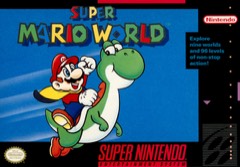
Mario, Luigi and Princess Toadstool go on holiday to Dinosaur Land, and Bowser ruins it. What follows is seven worlds of side-scrolling stages linked by one big overworld map, with fortresses run by the Koopalings, ghost houses, and Bowser's castle at the end. The map branches, and hidden keys unlock secret routes, the Star Road and a Special World, for 96 exits in all.
Two additions define it. The Cape Feather lets Mario glide, dive and, with a run-up, fly across whole levels. Yoshi, a dinosaur you can ride, swallows enemies and spits shells, gaining wings, fireballs or clouds of dust depending on the shell's colour. The game also adds a spin jump and a reserve box that holds a spare power-up for when you get hit.
Where it sits in history
Takashi Tezuka directed and Shigeru Miyamoto produced, with a team of about fifteen at Nintendo EAD. They started in October 1988, just after Super Mario Bros. 3, and quickly decided that simply porting that game to new hardware felt like more of the same. Miyamoto had wanted Mario to ride a dinosaur since the first game; the NES could not manage it. Koji Kondo rearranged a small set of themes across the whole game.
It launched the Super Famicom in Japan on 21 November 1990, alongside F-Zero, and reached North America on 23 August 1991, often packed in with the console. It went on to sell 20.61 million copies, the best-selling SNES game, and led to a prequel, Yoshi's Island, and a cartoon series.
How it plays today
It is still one of the most pleasant games to simply pick up. The controls are generous, the levels are short and full of alternate exits, and saving after each castle, fortress or ghost house means you can play in small bites. Hunting every exit gives it long legs.
The trade-off is challenge. The cape is so strong that a confident player can fly over large parts of the game, and most of the main route is easy by Mario standards. The real difficulty sits in the optional Special World. Some of the SNES colour now looks flat next to later games, but the music and the feel of Mario's movement have not aged at all.
Compared with
- Super Mario Bros. 3: Tighter and harder, with more variety of power-ups; World is bigger, friendlier and more about secrets.
- Super Mario World 2: Yoshi's Island: The 1995 prequel hands the lead to Yoshi and is a very different, slower-paced game.
- Donkey Kong Country: The SNES's other giant platformer: more cinematic and more punishing, with far less freedom of movement.
Why it matters
For a lot of people, Super Mario World was not a game they chose. It was in the box with the console, and so it became part of a house, a Christmas, a sibling hogging the controller. It sold more than 20 million copies, and a great many of the memories attached to it have other people in them.
Tim Wildschut and colleagues found nostalgia is mostly positive, often features close others, and raises social connectedness and self-regard. Which fits. Hum a few bars of Koji Kondo's music to someone who grew up with it and watch their face; it is rarely just the level they are remembering. The game makes going back easy, too. Short stages, a save after each castle, a map you can wander. It welcomes you back without asking how long you have been away, and that is a large part of what home means: somewhere that doesn't hold your absence against you. The cape still works.
Read: Why old games feel like home →
- Wildschut, T., Sedikides, C., Arndt, J., & Routledge, C. (2006). Nostalgia: Content, triggers, functions. Journal of Personality and Social Psychology, 91(5), 975-993. doi:10.1037/0022-3514.91.5.975
What you're levelling up
You have been training these without noticing. Here is how to do it on purpose, and where it pays off away from the couch. All the skills games teach →
Curiosity
In the game. Hidden keys open secret routes, the Star Road and a Special World, 96 exits in all. Most of the good stuff sits off the obvious path.
Do it on purpose. Pick a level you've already beaten and play it only to find the second exit. No guide for the first twenty minutes.
Off the couch. The best stuff often comes through the side door. Ask your date about the thing they mentioned in passing and actually want the answer. Curiosity is attractive.
Judging risk
In the game. The cape lets a confident player fly over whole levels, and the reserve box keeps a spare power-up for when you get hit. Both change how brave you can afford to be.
Do it on purpose. Play the Special World with one rule: no cape flights over the hard bits. Notice which risks you take with a spare in the box and which you don't.
Off the couch. A safety net makes you braver, which is good, until it makes you lazy. Savings work the same: they let you take a better job, not a dumber punt.
Bouncing back
In the game. The main route is easy by Mario standards. The Special World isn't, and that's where you'll die on the same jump over and over.
Do it on purpose. Pick the Special World level that's beating you. Count deaths per session, change one thing each attempt, and try to bring the number down.
Off the couch. The second job interview, the second go at a hard unit at uni. Treating a fail as information and going again is most of what getting good looks like.
Verdict · 10/10
A generous, endlessly replayable platformer that set the tone for the SNES. Easier than its NES predecessor, and still a joy.