What it was
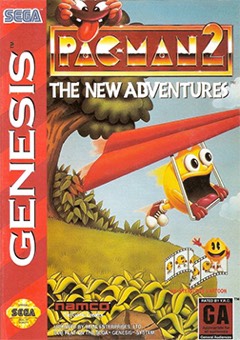
Namco moved Pac-Man out of the maze and into a town. He has a family now, and errands: milk for Pac-Baby, a birthday flower from the mountains for Pac-Jr.'s friend Lucy, Pac-Jr.'s guitar back from the ghosts in Pac-City. Behind it all the Ghost Witch of Netor is stealing the children's chewing gum and building a Gum Monster.
You never control Pac-Man. He walks about on his own, and you hold a slingshot. Fire at a thing to make him look at it, or at him to make him go. His mood is the puzzle: knock an apple from a tree and he eats it and cheers up; hit him in the face and he sulks. Too happy and he gets cocky and stops listening. When the ghosts appear he panics, unless you feed him a Power Pellet and he becomes Super Pac-Man, who flies and eats them. A town arcade has the original Pac-Man, and three hidden cartridges unlock Ms. Pac-Man.
Where it sits in history
Namco released it in 1994, as Hello! Pac-Man in Japan in August and Pac-Man 2: The New Adventures in North America in September. A Mega Drive version came out in the United States only. Its side-on town borrows from Pac-Land, and the family and the villain giving the ghosts orders echo the cartoon series.
Critics did not know what to do with it. GamePro called it innovative and sometimes fun but found not steering Pac-Man annoying. Entertainment Weekly gave it a C minus and said it took a dozen tries just to work out how to play. Famitsu readers gave it 7 out of 10.
How it plays today
It is lovely to watch. Pac-Man's animations are the reason to play: the slump when he is sad, the strut when he is smug, the panic at a ghost. The town is full of small things to poke at, and finding out how he reacts to each one is most of the fun.
The trouble is the same as in 1994. When you know exactly where he needs to go and he won't go there, it is maddening, and the fast chase sections ask for reflexes from a hero you can't steer. Treat it as a cartoon you nudge along, not a platformer, and it is far kinder.
Compared with
- Pac-Land: Namco's earlier side-on Pac-Man, which this game borrows its structure from.
- Pac-Man: The maze game, playable inside this one at the town arcade.
- Ms. Pac-Man: The unlockable reward for finding all three cartridges.
Why it matters
Almost every game hands you a body to drive. Pac-Man 2 hands you someone else, with moods, who may or may not do what you hope. It is closer to looking after a person than to being one, and it is frustrating for the same reasons.
Ryan, Rigby and Przybylski found that games satisfy needs for competence, autonomy and relatedness, and that predicts whether people enjoy them. Pac-Man 2 deliberately takes away your autonomy and offers relatedness instead: you learn what cheers him up, what scares him, when to leave him alone. Whether that trade works for you says a lot about what you come to games for.
Read: Who you are when you play →
- Ryan, R. M., Rigby, C. S., & Przybylski, A. (2006). The motivational pull of video games: A self-determination theory approach. Motivation and Emotion, 30(4), 344-360. doi:10.1007/s11031-006-9051-8
What you're levelling up
You have been training these without noticing. Here is how to do it on purpose, and where it pays off away from the couch. All the skills games teach →
Reading people
In the game. You never control Pac-Man, just a slingshot. His mood is the puzzle: too sad and he sulks, too happy and he gets cocky and stops listening.
Do it on purpose. Before every shot, look at Pac-Man's face and name his mood. Then pick a nudge that suits it.
Off the couch. Reading someone's mood before you speak is half of being good company. Knowing when a date needs a laugh and when they need quiet is gold.
Keeping your cool
In the game. When you know exactly where he needs to go and he won't go there, it's maddening.
Do it on purpose. Every time you feel the urge to fling the slingshot at his face, take a breath and try a gentler nudge.
Off the couch. Dealing with people who won't do what you want, a flatmate, a coworker, takes patience. Nagging rarely works on anyone.
Curiosity
In the game. The town is full of small things to poke at, and finding out how Pac-Man reacts to each one is most of the fun.
Do it on purpose. Fire at every odd object in one area to see how he reacts. Keep a list of the funny ones.
Off the couch. Being curious about how people tick, what makes them laugh, what bugs them, makes you easy to talk to.
Verdict · 6/10
A bold, odd experiment that makes you a nagging friend instead of a hero. Charming for an hour, and maddening when he won't listen.