What it was
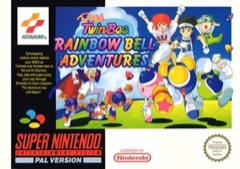
TwinBee was a vertical shooter series. This is the first time its heroes walk. You pick TwinBee, WinBee or GwinBee, and each of them fights with a punch that charges into a punch wave. Each also gets a weapon of their own, a hammer for TwinBee, a lasso for WinBee and throwing rattles for GwinBee, plus a gun.
All three can hover, and charge a rocket pack to fly in any of eight directions for a moment. The difference between them is timing. TwinBee is the all-rounder. WinBee charges her rocket the fastest but her punch wave the slowest. GwinBee is the other way round. The series' bells are back, but here you get them by beating enemies, not by shooting clouds, and each colour gives a different power-up: weapons, the gun, speed, options or invincibility.
Where it sits in history
Konami developed and published it for the Super Famicom on 7 January 1994, and it reached Europe the same year. North America never got it. The two releases are different games in places. In Japan the levels sit in a grid joined to each other, some with hidden second exits in the way Super Mario World does it; the European version runs in a straight line. The European cartridge also cuts the chatter from Dr. Cinnamon and the pilots on the level select, saves only with passwords where the Japanese cartridge has a battery, and drops the multiple endings that change with how well you play.
It sold about 36,601 copies in Japan, according to Famitsu. Micom BASIC Magazine ranked it tenth in popularity in April 1994, and critics were generally kind. There is also a versus mode, best of three rounds.
How it plays today
It is cheerful in a way few games bother to be now. The enemies are toys, the colours are sweets, and the rocket pack turns every jump into a small decision about when to let go. Picking a character is really picking a rhythm: wait for the rocket, or wait for the punch.
If you can, play the Japanese cartridge. The grid of stages, the secret exits and the endings that reward a clean run make it a fuller game than the European one.
Compared with
- Pop'n TwinBee: The 1993 SNES shooter these heroes come from.
- Sparkster: Konami's other rocket-pack platformer of 1994, harder and darker.
- Super Mario World: The map of joined stages and secret exits the Japanese version echoes.
Why it matters
The same game came out twice and was not the same. Japan got a map to wander, chatter on the level select and endings that answered how you played; Europe got a corridor. Someone decided what each audience would want, and the players never knew there was another version.
Caillois described a range from paidia, free and wandering play, to ludus, play bound by rules and order. The Japanese Rainbow Bell leans toward the wander, the European one toward the line. Neither is wrong, but it is a reminder that how much freedom a game gives you was always somebody's choice.
Read: The magic circle: the world that rules make →
- Caillois, R. (1958/1961). Man, Play and Games (trans. M. Barash).
What you're levelling up
You have been training these without noticing. Here is how to do it on purpose, and where it pays off away from the couch. All the skills games teach →
Timing and rhythm
In the game. Picking a character is picking a rhythm. WinBee's rocket charges fast and her punch wave slow, GwinBee the other way, so every jump is a call on when to let go.
Do it on purpose. Play a level as each of the three and notice which charge you keep releasing early. Then play it again with that one.
Off the couch. Timing is when to ask the question, when to tell the joke, when to finally message them back. Too early and too late both cost you.
Curiosity
In the game. In the Japanese version, stages sit in a grid with hidden second exits, the way Super Mario World does it. The map only opens up if you poke around.
Do it on purpose. Replay a cleared stage hunting only for the other exit. Don't move on until you've found it or ruled out every wall.
Off the couch. Curious people are good company. Ask the second question about someone's job or their weird hobby and the conversation finally gets interesting.
Pattern recognition
In the game. Bells come from beaten enemies now, not clouds, and each colour gives a different power-up. Know which colour you need before you grab one, and you stop playing on luck.
Do it on purpose. Pick one stage and write down where each bell colour came from. Run it again and grab only what you planned.
Off the couch. Noticing patterns at work, like which week your boss is stressed, means you pitch the idea on the right day.
Verdict · 7/10
Rainbow Bell Adventures is a sweet, well-made platformer that most of the world never saw. Find the Japanese version for the full map and the endings.