What it was
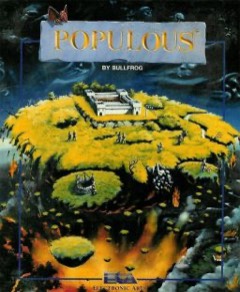
You are a god, and your worshippers are tiny walkers hunting for flat ground. Give them some and they build a house. More flat land means bigger houses, more houses mean more followers, and more followers fill your mana bar. Across the map a rival god is doing the same with a rival people, and only one side gets to stay.
Your basic power is raising and lowering the land, in an isometric view laid out on a tabletop with the world map as an open book. Build up mana and the fun stuff unlocks: earthquakes, floods, swamps, volcanoes, and turning an ordinary follower into a knight. Landscapes change from world to world, desert, snow and ice, rock and lava, and each one changes how your people grow.
Where it sits in history
Peter Molyneux led it at Bullfrog on a £20,000 budget, and Electronic Arts released it on the Amiga in March 1989. It began as a landscape full of little people, peeps, wandering until water stopped them. Molyneux added land raising to help them get about, then houses to thin out the crowd, and found he had a game. Bullfrog even prototyped it as a board game made from Lego. Nobody remembered to give the original's 500 levels an ending until testers asked for a cheat to reach it.
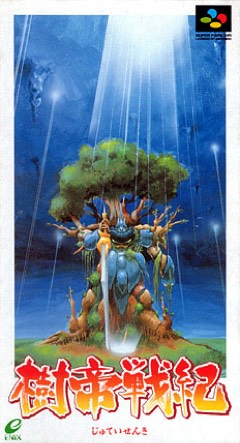
The Super Famicom version came from developer Infinity and publisher Imagineer, one of the console's original titles in Japan, in December 1990. Acclaim brought it to North America in September 1991. Its big addition is a new race based on the Three Little Pigs. Famitsu scored it 31 out of 40, and later Complex and IGN both put it on their lists of the best SNES games.
How it plays today
The idea still lands. Lifting a hill out of the sea so a village can spread, then sinking the ground under an enemy town, is a kind of power almost no other game hands you, and it feels mischievous rather than grand. Watching the mana bar creep up as houses spring from the ground is a lovely slow loop.
The pad is the catch. Steering a cursor over the land to shape each patch is slower than it should be, and that hurts when a rival is flooding your people. The worlds also blur after a while: flatten, grow, smite, repeat. In short bursts it charms. In long sessions you feel the repetition one early critic complained about.
Compared with
- Populous II: Trials of the Olympian Gods: The true sequel, from 1991, with more gods and more ways to ruin a rival's day.
- Powermonger: Bullfrog built it on the Populous engine and turned it into a war game in three dimensions.
- ActRaiser: Another SNES game where you play god over a growing people, with side-scrolling sword fights between the building.
- SimCity: Also builds from the ground up, but there's no rival god and nobody to smite.
Why it matters
Populous does something few games bother with: it shows you the table. The world sits on a tabletop, the map is an open book, and your power is a bar along the side. It never pretends you are anywhere but at play. Johan Huizinga, the Dutch historian, called play a magic circle, a space set apart from ordinary life with its own order. Populous draws that circle on screen, then hands you the most outrageous rule inside it: you can move the ground.
It began, fittingly, as a board game Bullfrog made from Lego. That is the charm of it. Under the floods and volcanoes it is the game kids play in a sandpit: building a hill for someone small to live on, then deciding, gleefully, to knock the other kid's down.
Read: The magic circle: the world that rules make →
- Huizinga, J. (1938/1949). Homo Ludens: A Study of the Play-Element in Culture.
What you're levelling up
You have been training these without noticing. Here is how to do it on purpose, and where it pays off away from the couch. All the skills games teach →
Spatial thinking
In the game. You shape an isometric landscape by raising and lowering the ground, so your followers have flat land to build on and the enemy has less.
Do it on purpose. Before you touch the land, pick the spot for your biggest town and work out how much ground needs flattening around it. Then do exactly that.
Off the couch. Rearranging a room, packing a ute, working out whether the couch fits before you carry it up three flights. Your mates will thank you.
Judging risk
In the game. Mana is your budget. Spend it on an earthquake now, or let it build towards floods and volcanoes while your rival does the same.
Do it on purpose. Play one world without spending mana on attacks until your bar is nearly full, then one where you strike early. Compare how each went.
Off the couch. The small win now or the big one later: a holiday, a car, a house deposit. Learn which way your gut leans and correct for it.
Making things
In the game. Followers build only where you give them flat ground, and bigger flats mean bigger houses. Every town on the map is one you shaped.
Do it on purpose. Pick one world and grow the biggest single town you can, ignoring the enemy until you're done.
Off the couch. Making something for someone you're seeing, a meal, a playlist, a shelf that doesn't wobble, says more than buying it. People remember what you made them.
Verdict · 7/10
The first god game, still clever and still a bit wicked, held back by a pad that was never made for shaping land. Play it in short sessions and it charms.