What it was
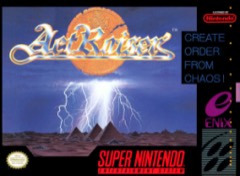
Half god game, half sword-swinging platformer, and nothing else on the SNES quite like it. You are the Master, a deity who wakes after centuries of sleep to find the world carved up by the Evil One, Tanzra, and his lieutenants, and your power faded because nobody believes in you any more.
Each of the world's regions plays in two modes. On the ground, you possess a statue and fight through a side-scrolling action stage to a boss. From the sky, you guide an angel over an overhead map as a small band of settlers grows into a civilisation: you point them where to build roads, clear land with lightning, rain and earthquakes, and shoot down the flying monsters that raid their homes. Seal the four monster lairs and the town flourishes. A bigger population means more hit points and magic for you, and a second action stage closes out each region.
Where it sits in history
Quintet developed it and Enix published it in Japan in 1990, within six months of the Super Famicom's launch. Yuzo Koshiro's score was one of the first to show what the console's sampled sound could do, and EGM named it best music of 1993.
In Japan the hero is God and the villain Satan. Nintendo of America's rules on religious content turned them into the Master and Tanzra, though the allegory is plain to see. The North American release also rebalanced the game, making the action easier and the town-building harder, and added a Professional mode of action stages alone. Quintet reported 620,000 copies sold worldwide.
How it plays today
The simulation half is the surprise. Nudging a village into a city, answering prayers and watching the population tick up is soothing and oddly moving, and the way it feeds your power in the action stages gives both halves a purpose. Koshiro's music is gorgeous throughout.
The action half is the weaker. The statue is stiff, jumps feel heavy, and the stages are short and plain next to the SNES's best platformers, though the bosses, drawn from mythology and religion, are memorable. The simulation can also get fiddly, with a lot of time spent shooting pests off the map. Taken as a whole, it is unusual and charming more than it is polished.
Compared with
- ActRaiser 2: The 1993 sequel. Start with the original, where the two halves were first put together.
- SimCity: The deeper city-builder on the SNES; ActRaiser is lighter and gives you boss fights instead of budgets.
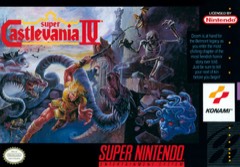
- Super Castlevania IV: If you only want the sword-and-platform half, this does it far better; ActRaiser has the ideas.
Why it matters
ActRaiser begins with a god who has lost power because nobody believes any more. You win it back the slow way: answering prayers, clearing land with rain and lightning, watching a few settlers turn into a town. It is a strange, gentle fantasy to put in a cartridge, and a revealing one.
Andrew Przybylski and colleagues found games are most engaging when playing a character brings people closer to their ideal self. So what ideal does ActRaiser offer? Not conquest. Care. Your strength grows with the population; you are only as mighty as your people are well. Donald Winnicott saw play as the space between inner and outer worlds, where people are creative and find a self. The town screens feel like that space: somewhere to try being patient, protective and useful, with nothing real at stake. Plenty of games let you be a hero. ActRaiser lets you be responsible, and makes that feel like power.
Read: Who you are when you play →
- Przybylski, A. K., Weinstein, N., Murayama, K., Lynch, M. F., & Ryan, R. M. (2012). The ideal self at play: The appeal of video games that let you be all you can be. Psychological Science, 23(1), 69-76. doi:10.1177/0956797611418676
- Winnicott, D. W. (1971). Playing and Reality.
What you're levelling up
You have been training these without noticing. Here is how to do it on purpose, and where it pays off away from the couch. All the skills games teach →
Systems thinking
In the game. Clear land with lightning, point settlers at roads, seal the monster lairs, and the town grows. A bigger population feeds your hit points and magic in the action stages. Every bit pushes on every other bit.
Do it on purpose. Next region, change just one thing: seal the lairs before building anything else. Watch how fast the population ticks up compared to last time.
Off the couch. Your sleep feeds your training, your training feeds your mood, your mood feeds how you go at work. Fix the thing upstream and three things downstream fix themselves.
Curiosity
In the game. The villagers send prayers up to you, and answering them is half the charm. Poke around the town and see what each request changes.
Do it on purpose. Spend one session just reading every prayer and doing what they ask before you rush the next action stage. See what you'd been missing.
Off the couch. Ask your date what they're into, then ask the follow-up. Actually wanting to know is the whole trick, and it's rarer than it should be.
Pattern recognition
In the game. The bosses are drawn from mythology and each runs its own set of attacks. The statue's stiff, so knowing the pattern is how you win, not reflexes.
Do it on purpose. On one boss, don't attack for the first thirty seconds. Just watch and name its moves in order, then fight.
Off the couch. Your manager has a pattern for bad news, your mate has a pattern for bailing. Spot the loop and you stop being surprised by it.
Verdict · 8/10
A one-of-a-kind blend of god game and action platformer with a superb score. The action is merely decent; the idea is what lasts.