What it was
Four plays. That is the entire playbook for most teams in Tecmo Bowl, usually two runs and two passes, and it is enough. On defence you guess which one the other side picked; guess right and the line collapses, the receivers are blanketed and you are one button away from a sack. Guess wrong and someone is running for the end zone.
The NES version puts nine players a side on the field, gives you twelve teams named only by their city, and fills their rosters with real NFL players from the late 1980s. You can play the computer through a password-saved season, play a friend, or pick plays as coach while the game runs the action.
Where it sits in history
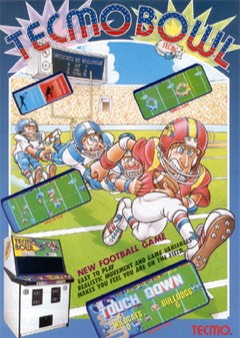
Tecmo made it first for arcades in 1987, a two-screen cabinet with fictional teams and room for four players. The NES port followed in 1989 and became the first console game with real NFL players, through a licence from the players' association. Tecmo could not get the league licence for team names, which had gone to LJN, hence the city-only teams.
It was a hit in the United States, and it led to Tecmo Super Bowl in 1991. The series had sold five million units by mid-2007, and the NES game still has a tournament scene, enough to carry a 2022 documentary about its best players.
How it plays today
Remarkably well, and mostly because it refuses to simulate football. A game takes minutes, the play-call guessing is a tense little bluffing contest, and the players you remember from the roster actually play like themselves, some running backs almost impossible to bring down. Against another person it is as good as it ever was.
Alone, the limits show sooner. With a handful of teams and plays, the computer's tendencies are easy to learn, and a season against it becomes routine once you find the play that works. There is nothing to manage between games. It is a party game in a football helmet, and better for it.
Compared with
- Tecmo Super Bowl: The 1991 sequel builds on this one; start here to see how little the formula needed.
- 10-Yard Fight: An early NES football game with none of Tecmo Bowl's speed or personality.
- NFL: Atlus's NES game had the real teams but no real players; Tecmo Bowl had the players, and the players were what mattered.
Why it matters
Four plays and a guess. Tecmo Bowl strips American football down to a bluff between two people on a couch: you pick a play, they pick a defence, and for one second the whole room waits to see who read whom.
Roger Caillois sorted play into kinds, and agon, competition, sits first. But Tecmo Bowl's contest barely happens on the screen. It happens in the side-eye, the fake sigh before you pick a pass, the friend who always runs on third down. Erving Goffman wrote that a game creates a shared world with its own rules of relevance, and that engrossment together makes an encounter feel alive. For five minutes nothing matters except which of two runs your mate chose. That is why the computer gets boring and a person never does, and why grown adults still gather for tournaments on a 1989 cartridge. It was never really about the football.
Read: The second controller →
- Caillois, R. (1958/1961). Man, Play and Games (trans. M. Barash).
- Goffman, E. (1961). Encounters: Two Studies in the Sociology of Interaction ('Fun in Games').
What you're levelling up
You have been training these without noticing. Here is how to do it on purpose, and where it pays off away from the couch. All the skills games teach →
Reading people
In the game. Four plays, and on defence you guess which one he picked. Right and the line collapses; wrong and someone's off to the end zone.
Do it on purpose. Against a mate, write down his play every down for one half. At half-time read the list and call his next three.
Off the couch. Most people have a go-to move when they're nervous. Spot it and you know when to ease off, at work or when your date is a bit shy at first. Being easy to be around starts there.
Pattern recognition
In the game. Alone, the computer's tendencies are easy to learn, and once you find the play that works a season turns routine.
Do it on purpose. In your next season game, note the computer's call every down. By the second half, defend only on what your notes say.
Off the couch. Things that look random usually aren't: your boss's moods, the rent rise every year. Spot the pattern and stop being surprised.
Keeping your cool
In the game. The play call is a tense little bluffing contest, a game takes minutes, and once you pick you can't take it back.
Do it on purpose. Next game, decide your play before your mate does and don't change it. Notice how often second-guessing cost you.
Off the couch. Committing calmly to a choice, a job offer, a flat, a booking, beats dithering. Confidence is mostly not flinching.
Verdict · 8/10
Stripped-back, fast and built for two players on one couch. Still one of the most fun sports games on the NES.