What it was
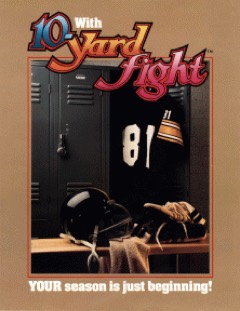
Football seen from above, scrolling up the field. There is no playbook. On offence you take the snap and choose: run with the quarterback, pitch it to a running back, or throw long to the one receiver. On defence you pick one of two players and the computer moves the rest. You can punt and try field goals too.
Win both halves at one level and you move up the ladder: high school, college, professional, playoff, Super Bowl. Each half is thirty minutes of sped-up clock, and a kickoff returned for a touchdown is worth 20,000 points.
Where it sits in history
Irem made the arcade game in 1983; Taito distributed it in North America and Electrocoin in Europe. It was the top-earning new table cabinet in Japan in December 1983. The arcade version only let you play offence. For the NES, Tose added defence and a two-player mode, and Irem published it in Japan in 1985 while Nintendo released it in North America that year and Europe in 1986.
It was one of only two NES launch games first developed outside Nintendo, both of them Irem arcade games; the other was Kung Fu. Irem also ported it to the MSX in Japan, and Hamster put the arcade version in its Arcade Archives series in May 2018. Sports Illustrated's Adam Duerson said few people remember it, but it moved football games on from the Atari era.
How it plays today
Not as football. N-Sider had it right: it feels like a racing game, a dash to the next first down before time runs out. Played on those terms it has some pace and a decent tune.
Played as football it is shallow. With no plays to call, every down is the same choice, and the computer's players do most of the work on defence. Two players helps, but Tecmo Bowl arrived and made this one a museum piece.
Compared with
- Tecmo Bowl: The NES football game most people remember instead.
- Tecmo Super Bowl: Tecmo's follow-up, much fuller.
- Kung Fu: The other Irem arcade game in the NES launch line-up.
Why it matters
Bernard Suits defined playing a game as 'the voluntary attempt to overcome unnecessary obstacles'. Football is already a pile of agreed obstacles. 10-Yard Fight strips most of them away and keeps one: ten yards, before the clock runs out.
What is left still works. Take away the playbook, the names and the rules lawyers, and people will happily run at a line for the sake of reaching it. The obstacle is the fun, even when it is the only one.
Read: The magic circle: the world that rules make →
- Suits, B. (1978). The Grasshopper: Games, Life and Utopia.
What you're levelling up
You have been training these without noticing. Here is how to do it on purpose, and where it pays off away from the couch. All the skills games teach →
Judging risk
In the game. No playbook, just one call every snap: keep it with the quarterback, pitch it, or throw long to your one receiver. The clock's sped up, so a bad punt on the wrong down costs you the half.
Do it on purpose. Next half, say your call before the snap and why. Count how many long throws actually land compared to the runs.
Off the couch. Most decisions at work are this: three options, not enough info, a clock running. Make the call, own it, learn from it. Dithering is still a choice, just a worse one.
Timing and rhythm
In the game. It plays like a racing game, a dash to the next first down. When you pitch to the running back decides whether he finds a gap or gets buried.
Do it on purpose. Pick one play, the pitch, and run it every down for a quarter. Note the moment it works and wait for that moment every time.
Off the couch. Same instinct tells you when to ask for the raise, or when to say the thing you've been sitting on to someone you like. A beat early is nerves, a beat late is a missed chance.
Winning and losing well
In the game. Two players is where it lives. It's shallow enough that whoever's ahead can grind their mate into the turf all half.
Do it on purpose. When you're up by two touchdowns against a mate, try only long throws for the rest of the half. Make it a contest again.
Off the couch. Nobody remembers the score of a footy kick-around, they remember who was a good sport. Win quietly, lose with a grin, and people keep inviting you back.
Verdict · 4/10
A historical step for football games and a short, oddly fun sprint. Interesting for an evening of NES history, not for a season.