What it was
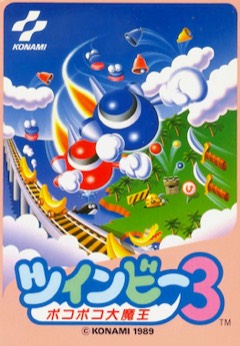
TwinBee and WinBee, two round little ships, go after their baby brother GwinBee, kidnapped by the evil king Poko Poko while out on an errand. You fly up the screen, shooting at things in the air with one button and bombing things on the ground with the other.
Shoot the clouds and bells fall out. Shoot a bell and it changes colour: yellow for points, blue for speed, white for a double shot, red for a laser, and flashing ones for copies of your ship or a shield. Lose both of your ship's arms and you cannot bomb until an ambulance flies in to fix them. Fly side by side with a friend and you fire a wide spread of stars; line up one above the other and a star circles you both.
The enemies are musical instruments, banana-shaped crocodiles, witches and an octopus or two. One boss is a ghost ukulele band. Another is the cavities in a giant dragon's teeth.
Where it sits in history
Konami made and published it for the Famicom on 29 September 1989. It was the third TwinBee there, after the home version of the original and Moero TwinBee, which reached North America as Stinger. TwinBee 3 never left Japan.
It dropped Moero's sideways stages and its three-player mode and went back to the original's straight climb, for one or two players. It also got easier on purpose: you can set the difficulty to 'comfortable' or 'hell', pick how many ships you start with and choose the order of the first four stages. The Famicom speaks, too: a voice calls the name of each stage and the conga music in one stage chants 'Poko Poko'. Konami put it on its i-Revo download service in 2006.
How it plays today
The new idea holds up best. When your ship goes down it leaves a ghost floating where it died, and if you fly back and touch it you get every power-up back. One mistake no longer ends the run. A shooter that once punished you for blinking now lets you pick yourself up.
The bells still take juggling to get the colour you want, and doing it with a second player beside you is the best way to play.
Compared with
- Stinger: The one before it, with sideways stages and three players, and the one Americans got.
- Pop'n TwinBee: The Super Famicom follow-up, which also reached Europe.
- Gradius: Konami's serious shooter, where losing a ship costs you everything.
Why it matters
In a shooter, one hit can take the speed, the guns and the shield you spent a stage building. TwinBee 3 leaves your past self hanging in the air, waiting for you to come back for it.
Juul calls it the paradox of failure: we avoid failing in life, yet seek it out in games, because failing makes us rethink and get better. TwinBee 3 keeps the failure and softens the cost, so the lesson stays and the punishment goes. You lose, you go back, you pick up who you were.
Read: One must imagine Mario happy →
- Juul, J. (2013). The Art of Failure: An Essay on the Pain of Playing Video Games. MIT Press.
What you're levelling up
You have been training these without noticing. Here is how to do it on purpose, and where it pays off away from the couch. All the skills games teach →
Bouncing back
In the game. When your ship goes down it leaves a ghost, and touching it gives every power-up back. One mistake no longer ends the run.
Do it on purpose. After every death, go straight for the ghost and note how fast you're back to full. Make recovery the score.
Off the couch. A bad day isn't the end of the run. People who go back for their stuff, call the mate, finish the course, recover faster than they fear.
Teamwork
In the game. Fly side by side with a friend for a wide spread of stars, or line up one above the other and a star circles you both.
Do it on purpose. Play a stage with a mate and call your formation before each wave. Count which one clears it faster.
Off the couch. Being in step with someone, on a dance floor, in a kitchen, at work, is attractive. You're both better for it.
Timing and rhythm
In the game. Shoot a bell and it changes colour. Getting the one you want, laser, speed or double shot, means juggling it in the air.
Do it on purpose. Pick one colour, say red for the laser, and juggle every bell to it for a stage. Count the shots each bell takes.
Off the couch. Knowing when to stop, like the extra shot that ruins the bell, is a big part of good timing in a chat or a joke.
Verdict · 7/10
A cheerful, forgiving shooter with a ghost that hands back what you lost. Worth importing for two players.