What it was
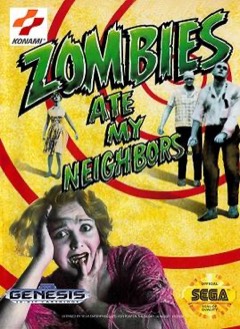
Dr. Tongue, a mad scientist, has bred monsters in his castle and let them loose on the suburbs. Two teenagers, Zeke and Julie, grab whatever is lying around and go to save the neighbours. One player takes either kid, or two players take both.
You run through backyards, shopping malls, pyramids and castles. Every stage hides up to ten neighbours: teachers, babies, tourists, soldiers, dogs, cheerleaders. Touch one and they are saved. Let a monster touch one first and they are gone for the rest of the game. Save at least one to open the exit. Lose them all and the game ends.
The weapons are the joke and the strategy. A squirt gun, weed whackers, soda can grenades, ice pops, tomatoes, plates, cutlery, a bazooka. Each monster has a weakness out of the old films: cutlery kills a werewolf in one hit, and a crucifix finishes a vampire faster. On some stages the sun goes down, and at nightfall the tourists turn into werewolves.
Where it sits in history
LucasArts developed it and Konami published it in 1993. The team built it on the Super NES first and started the Sega Genesis version about halfway through. Joe McDermott wrote the music. The team wanted a battery save and could not afford one. The Super NES version has a flamethrower the Genesis one lacks. The same engine later ran Ghoul Patrol, Metal Warriors and Big Sky Trooper.
Nintendo of America turned the blood purple. Censors in a dozen European countries went further, renamed the game Zombies, and swapped the chainsaw maniacs for lumberjacks with axes. Australia got it as Zombies too.
It did not sell well at first, but reviews were good, mostly for the humour, the two-player mode, the art and the music, and it grew into a cult classic. IGN ranked it 48th among Super NES games and gave the 2009 Wii release an Editor's Choice award. In June 2021 Dotemu's port put it and Ghoul Patrol on modern consoles.
How it plays today
It holds up because it is generous. The stages are short, the jokes land in the stage names and the enemies, and every new weapon makes you rethink what you are carrying. It is fair, too: your score keeps buying you more neighbours and lives.
Play it with two. Alone it is a good shooter. With a friend it turns into a running argument about who grabs the baby and who covers the door, and that is the game it wants to be. The one complaint that sticks is the one Complex made: after a few dozen stages, they start to look alike.
Compared with
- Ghoul Patrol: The 1994 sequel on the same engine, with the same horror-movie jokes.
- Smash TV: Another Super NES shooter for two that fills the screen with enemies.
- Contra: Nintendo Life called Zombies a B-movie Contra, and the two-player run-and-gun is the link.
- Metal Warriors: LucasArts reused the Zombies engine for this mech game.
Why it matters
Zombies gives two kids a job: save the people next door. You cannot save them all. Each neighbour you lose is gone for good, and you feel it, because you knew the cheerleader was over there and you went for the bazooka first. With two players, every loss is shared and every save gets shouted about.
Goffman wrote that a game builds a shared world with its own rules about what matters, and that being caught up in it together is what makes an encounter feel alive. On a couch in 1993, what mattered was a baby in a backyard and a chainsaw coming over the hedge. Nothing outside the screen mattered as much, and two people knew it at once.
Read: The second controller →
- Goffman, E. (1961). Encounters: Two Studies in the Sociology of Interaction ('Fun in Games').
What you're levelling up
You have been training these without noticing. Here is how to do it on purpose, and where it pays off away from the couch. All the skills games teach →
Teamwork
In the game. With a friend it becomes a running argument about who grabs the baby and who covers the door. Let a monster reach a neighbour first and they're gone for the rest of the game.
Do it on purpose. Before each stage, split the neighbours: you go left, your mate goes right. Count how many you save compared to a free-for-all.
Off the couch. Splitting the jobs and calling them out loud is how moving day, a group trip and a work rush go well. The mate who covers the door gets invited back.
Problem solving
In the game. Each monster has a weakness out of the old films: cutlery kills a werewolf in one hit, and a crucifix finishes a vampire faster.
Do it on purpose. Next stage, name each monster's weakness before you fire and switch to the right weapon. Note how much ammo you save.
Off the couch. Right tool, right job. Fixing a tap, sorting a blue with a mate, answering a hard email: match the fix to the problem.
Judging risk
In the game. Save at least one neighbour to open the exit, but every one you leave is gone for good. Chasing the last tourist as night falls is a real bet.
Do it on purpose. Set a rule each stage: if saving a neighbour costs more than half your health, leave them. Check whether you get further.
Off the couch. Knowing when to cut your losses, on a bad investment, a dead-end job or a date that clearly isn't working, is grown-up stuff. Leave kindly and save your energy.
Verdict · 9/10
A horror film made by people who loved horror films and could laugh at them. Get a second player and a fresh box of cutlery.