What it was
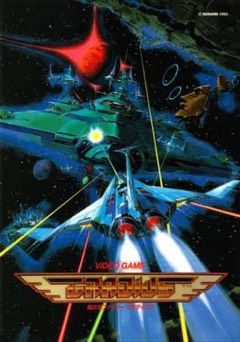
You fly the Vic Viper from left to right through alien worlds, past enemies and a stage guarded by stone Moai heads, a nod to the Nazca lines of Xevious. It starts slow, with a weak gun. Shoot the right enemies and they drop capsules, and each capsule moves a light one step along a menu at the bottom of the screen. Press the power-up button when the light sits on what you want, and you get it.
Bosses are big ships with blue cores at their centre, reached down a narrow channel of small walls you must shoot away first. Hit the core enough and it turns red before it blows. Destroy the core: it became the series' catchphrase.
Where it sits in history
Konami designer Machiguchi Hiroyasu built Gradius as a follow-up to Scramble, aiming to beat Namco's Xevious. The team tested more than twenty movement patterns for the Option drones and made the power meter so players could choose their weapons freely, an idea taken from keyboard function keys. The arcade game, sold outside Japan as Nemesis, was a major success in 1986.
The Famicom version came out in Japan on 25 April 1986 and sold over a million copies there that year; the NES version, Konami's first NES game in North America, followed in December. The hardware forced cuts: simpler stages and two Options instead of four. It also added a code, entered on the pause screen, that granted nearly every power-up. Konami kept using it in Contra, Life Force and many more, and it became known as the Konami Code.
How it plays today
It holds up well because the power meter is still a good idea. Take speed early so you can dodge, or bank capsules for something stronger? Every run is a little plan, and the boss cores give each stage a clear finish line.
It is hard, and losing a ship stings, because a well-built Vic Viper is worth far more than a fresh one. Use the code if you just want to see the stages; play it straight if you want the real thing.
Compared with
- Life Force: The Salamander spin-off on the NES, one of the later Konami games that kept the Konami Code.
- Gradius II: The Famicom sequel, with four weapon sets to pick from and a boss rush. Japan only.
- Xevious: The shooter Gradius set out to surpass.
Why it matters
Gradius's power meter exists because its makers wanted players to choose. Self-determination research by Ryan, Rigby and Przybylski found that games satisfy needs for competence, autonomy and relatedness, and that this predicts enjoyment and wanting to play again. The meter is autonomy made visible, a row of choices you make while being shot at.
The Konami Code adds relatedness. A secret passed from one kid to the next, then from game to game for decades, it turned a cheat into a shared language. People who have never played Gradius still know it.
Read: Who you are when you play →
- Ryan, R. M., Rigby, C. S., & Przybylski, A. (2006). The motivational pull of video games: A self-determination theory approach. Motivation and Emotion, 30(4), 344-360. doi:10.1007/s11031-006-9051-8
What you're levelling up
You have been training these without noticing. Here is how to do it on purpose, and where it pays off away from the couch. All the skills games teach →
Judging risk
In the game. Each capsule moves a light along the power meter. Take speed early so you can dodge, or bank capsules for something bigger? Every run is a stack of small bets.
Do it on purpose. Play one run grabbing the first thing you can every time, and one banking for lasers. Compare how far you get.
Off the couch. Spend the pay now or bank it for something better? Same light moving along the meter. Learn where your sweet spot is.
Keeping your cool
In the game. Losing a ship stings, because a well-built Vic Viper is worth far more than a fresh one. The next life is where most runs fall apart.
Do it on purpose. After you lose a ship, take one breath, then play the next ten seconds safe while you rebuild.
Off the couch. One bad moment on a date, the spilt drink, the joke that fell flat, doesn't have to sink the night. Breathe, laugh it off, carry on.
Hand-eye coordination
In the game. Bosses keep their blue cores down a narrow channel of small walls you have to shoot away first, all while they're shooting at you.
Do it on purpose. At each boss, try to clear the walls in as few shots as you can. No spraying: every shot has a reason.
Off the couch. Parallel parking, catching a ball, threading a needle. Steady hands under a bit of pressure is a quiet kind of impressive.
Verdict · 8/10
The shooter that let you build your own ship, and gave the world a cheat code it still knows by heart. Hard, fair and still sharp.