What it was
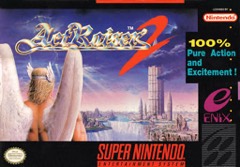
You are the Master, a winged god in a floating palace. You look down on the world, hear what is going wrong in each land, and drop in to fix it with a sword, a shield and a handful of magic scrolls. Each land has two acts: the first is ruled by a lesser demon named after a misfortune, the second by one of the seven deadly sins.
The wings change everything about moving. You jump, fly, fall and float between platforms, and the shield turns away some attacks. Magic comes from holding a button to charge it and letting go, and what comes out depends on where you are and how you're standing. Scrolls are limited each time you go down, so you learn which spell suits which moment. Turn the difficulty up and spells take longer to charge and monsters take more hits. The final area, Death Heim, is shut to you on Easy.
Where it sits in history
Quintet made it and Enix published it. Quintet said Enix of America asked for the sequel and set out what it should be. It came out in Japan on 29 October 1993, in North America in November, and in Europe in 1994 through Ubisoft. The villain Tanzra was called Satan in Japan, and the Master was simply God.
The first ActRaiser swapped between platform stages and building towns for your people. The sequel dropped the towns entirely and borrowed its shape from Paradise Lost and the Divine Comedy: a fallen servant, seven sins, a Tower of Babel and a devil frozen to the waist in a lake of ice. Quintet reported 180,000 copies sold, 100,000 of them in North America. A Saturn remake of both games was announced in 1996 and turned into a different game halfway through, and a third ActRaiser for the Nintendo 64 was never finished.
How it plays today
It looks and sounds like a big game, and the wings make even simple rooms feel open. Charging a spell and choosing where to stand before you let it go is a good idea that rewards patience.
It is also stiff and punishing, and it misses the thing people loved about the first one. With no towns to tend between fights there is no rest, and no sense that anyone below is better off for your trouble. Fans of hard platformers will get the most from it; anyone hoping for the city-building should go back to the original.
Compared with
- ActRaiser: The original, which alternates the sword with building towns and is the better game for it.
- Super Castlevania IV: Another dark, gothic SNES action game, with tighter controls.
- Demon's Crest: A winged hero, a demonic world, and a similar taste for difficulty.
Why it matters
The ending is the best thing in it. After the last fight the Master vanishes, the people declare that he will live forever, and the credits roll over his statue wearing away: the sword falls, then a wing. The first game hinted at the same thing, that one day the world might manage so well on its own it forgets who made it.
Ryan, Rigby and Przybylski found that games satisfy three needs: to feel capable, to choose for ourselves, and to feel connected to others. ActRaiser 2 gives the player plenty of the first. Its ending hands the second to the people below, and treats being outgrown as the point of the whole job.
Read: Who you are when you play →
- Ryan, R. M., Rigby, C. S., & Przybylski, A. (2006). The motivational pull of video games: A self-determination theory approach. Motivation and Emotion, 30(4), 344-360. doi:10.1007/s11031-006-9051-8
What you're levelling up
You have been training these without noticing. Here is how to do it on purpose, and where it pays off away from the couch. All the skills games teach →
Keeping your cool
In the game. Spells only fire after you hold the button to charge, and on the higher settings the charge takes longer while monsters keep coming. Panic and let go early, and you've wasted a scroll.
Do it on purpose. Pick one tough room and commit to charging every spell fully before you release, even when it feels too slow. Count the scrolls you save.
Off the couch. Waiting under pressure is a rare skill. In a heated meeting or an awkward silence on a date, whoever can hold it a second longer says the better thing.
Planning ahead
In the game. Your scrolls are limited each time you drop into a land, so you've got to decide which spell is worth spending where. Blow them early and the sin waiting at the end of act two eats you.
Do it on purpose. Before each act, decide how many scrolls you're allowed before the boss. Stick to it and see if you arrive with something left.
Off the couch. That's a budget, mate. Rent, savings, a holiday fund. Decide where the money goes before payday and you're not scrambling by the end of the month.
Bouncing back
In the game. It's stiff and punishing, and the wings take a while to feel natural. Most players die a heap before the floaty jumps make sense.
Do it on purpose. Pick the stage that beats you most and play it three times in a row. Write one thing you'll change after each death.
Off the couch. First week of a new job, first month at the gym, first go at anything. It feels clumsy, then it doesn't. The trick is showing up for attempt four.
Verdict · 6/10
A handsome, hard platformer that threw away half of what made its parent special. Worth playing once, mostly for the ending.