What it was
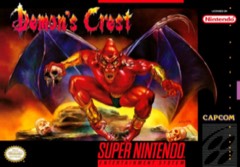
Six Crests rule the elements of the Demon Realm, and whoever holds them all gets infinite power. Firebrand, a red demon, had five and won the sixth from a dragon, but the fight left him weak. A rival demon, Phalanx, ambushed him and took them. The game starts with Firebrand locked in an arena, made to fight the dragon's zombie.
From there you pick your stages from a map and come back to them. Firebrand breathes fire, clings to walls and hovers on his wings. Each Crest you win changes him: a gargoyle for the ground, one for the air, one for water, and stronger forms after that. New forms open old stages, so a level you cleared hides a boss you could not reach the first time. Spells, potions and talismans fill out a light role-playing layer.
Phalanx's general, Arma, keeps challenging you and, out of respect, keeps handing Crests back. How you finish decides what Firebrand does with them: leave the realm to anarchy, hide them away, or throw them off a cliff because he does not want to rule. The best ending gives a password to a fourth.
Where it sits in history
Capcom developed and published it. It came out in Japan on 21 October 1994 as Demon's Blazon, and in North America in November. It is Firebrand's third game, after Gargoyle's Quest and Gargoyle's Quest II. In Ghosts 'n Goblins he is one of the demons Arthur fights, called Red Arremer in Japan.
Reviews liked it. Electronic Gaming Monthly's editors praised the visuals and the depth, and GamePro liked the macabre art and the use of each new power but found the music repetitive. Sales were another story. Famitsu counted 26,245 copies in Japan over its life, and Nintendo Power reported one week where more copies came back for refunds than went out. Capcom counted it a failure inside the company and later turned down a Game Boy Advance port.
How it plays today
It looks like nothing else on the console: rust, bone and dark water, with a Firebrand who is small, quick and mean. Hovering feels limited at first, and that is deliberate. Each Crest gives you a new way to move, and the map fills with places you now know you can reach.
You can face Phalanx without everything, but the endings worth seeing ask for more, and chasing them is the game.
Compared with
- Super Ghouls 'n Ghosts: The series Firebrand comes from, where he is the enemy that keeps killing you.
- Super Metroid: The same year's Super NES game of coming back to old places with new powers.
- Super Castlevania IV: The other gothic Super NES action game, more linear and better known.
Why it matters
Firebrand began as a problem for someone else's hero. Here the camera turns around and you are the monster, wanting power because you once had it. Then the game asks what you will do with it, and lets you answer.
Gee calls it a projective identity: the character becomes a blend of who you are and what you want that character to be. Demon's Crest leaves room for that blend. One player's Firebrand is a conqueror, another's throws infinite power off a cliff, and the ending tells you which one you made.
Read: Who you are when you play →
- Gee, J. P. (2003). What Video Games Have to Teach Us About Learning and Literacy.
What you're levelling up
You have been training these without noticing. Here is how to do it on purpose, and where it pays off away from the couch. All the skills games teach →
Curiosity
In the game. Each Crest changes Firebrand and opens old stages, so a level you cleared hides a boss you couldn't reach the first time.
Do it on purpose. Every time you get a new form, go back to one finished stage and poke at everything.
Off the couch. Going back to old haunts with new eyes, an old hobby, a mate you lost touch with, often turns up the best stuff.
Spatial thinking
In the game. Fire, wall clinging, hovering, then gargoyle forms for ground, air and water. The map fills with places you now know you can reach.
Do it on purpose. Keep a list of every spot you couldn't reach. Tick them off as new forms come.
Off the couch. Learning a new suburb or a new job the same way, noting the doors you can't open yet, makes you the one who knows the back way in.
Story sense
In the game. How you finish decides what Firebrand does with the Crests: leave the realm to anarchy, hide them, or throw them off a cliff because he doesn't want to rule.
Do it on purpose. Before the end, decide which ending you think Firebrand deserves, then chase it.
Off the couch. Knowing what you'd do with power is a decent test of character. People trust the one who doesn't want it for its own sake.
Verdict · 9/10
The best Super NES game almost nobody bought. Play as the monster, collect the Crests, and see which kind of demon you turn out to be.