What it was
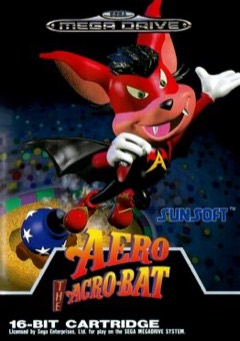
Aero is a red bat who happens to be the biggest star at a circus and funpark. A rich kid called Edgar Ektor, banned from the place after a prank nearly killed a lion, grows up into a nasty industrialist. With a squirrel called Zero and a gang of circus-themed goons, he wrecks the park and kidnaps the performers, Aero's girlfriend Aeriel included. You're the only one left to get them back.
It's a 2D platformer with a twist: you can't just run to the end. Each level has a job to do before the exit warp shows up, like flying through hoops, stepping on platforms until they vanish, or riding roller coasters. There are four worlds of five levels, and the levels are big. Aero shoots a limited supply of stars, or drops onto enemies with a diagonal drill attack. Collect enough points and you get a bonus dive into a pool, which on the SNES became a Mode 7 flight over a map.
Where it sits in history
David Siller had Aero in his head for years and sketched him in 1992. Early designs looked like a human acrobat, but Siller always meant him to be a bat. The mechanics were partly based on Namco's Mappy games. His son Justin Siller did the final look, pulling from 70s and 80s themes. It was planned for the NES first, but 16-bit consoles had arrived and that version was cancelled. The SNES and Genesis versions were built side by side.
Iguana Entertainment developed it and Sunsoft published it in 1993, with Aero as the company's new mascot. It had a showing at both the Winter and Summer Consumer Electronics Shows that year. Sunsoft even gave away free copies to the first 100 people who posted in a 3x5 postcard. Critics were split. Electronic Gaming Monthly gave the SNES version 8.3 out of 10 and named Aero Best New Character of 1993, while Digital Press handed it a 3 out of 10.
A sequel followed in 1994. Siller later planned a third, Aero the Acrobat 3D for PlayStation, but it never got going: Universal, who then held the rights, put its money on Crash Bandicoot instead.
How it plays today
The hoop-and-platform tasks give each stage a bit of a puzzle feel, but the levels are long and some of them are laced with awkwardly placed spikes that kill you outright. That's the cost of the design: you'll learn a stage by dying in it. If one-touch deaths put you off, the big levels will test you. If you like learning a layout, this is a good one.
Check the music before you judge it. Electronic Gaming Monthly flagged the SNES soundtrack as exceptionally good.
Compared with
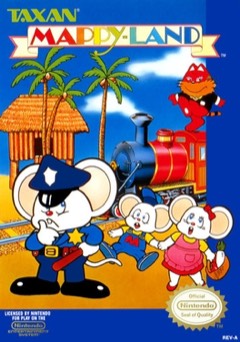
- Mappy: The Namco series that partly inspired how Aero plays.
- Aero the Acro-Bat 2: The 1994 sequel, on the same console.
- Sparkster: Another 16-bit animal mascot platformer, built on a different gimmick.
Why it matters
Juul calls it the paradox of failure: we dodge failing in everyday life, yet seek it out in games, because failing makes us stop, think and get better. Aero is a tidy case. A spike kills you in one touch, so every death comes with a lesson about where you went wrong.
Play it that way and the cost of dying is small and the payoff is real. You come back to the same hoop, the same ledge, with a better plan, and nobody is hurt but your pride.
Read: The zone: why good games make time disappear →
- Juul, J. (2013). The Art of Failure: An Essay on the Pain of Playing Video Games. MIT Press.
What you're levelling up
You have been training these without noticing. Here is how to do it on purpose, and where it pays off away from the couch. All the skills games teach →
Bouncing back
In the game. Spikes in the big levels kill Aero in one touch, so you die often and restart the stretch.
Do it on purpose. After a death, say what killed you in one sentence before pressing start. Then change one thing.
Off the couch. Copping a knockback at work or on a first date and going again without spiralling.
Planning ahead
In the game. Each level wants a job done first, like every hoop flown through, before the exit warp appears. You can't just run for the end.
Do it on purpose. Before you move, find the whole checklist for the stage and pick an order.
Off the couch. Sorting a Saturday of errands so you're not driving across town twice.
Spatial thinking
In the game. The levels are large and the platforms and hoops are scattered, so you build a map in your head.
Do it on purpose. Look at a stage's layout for ten seconds, then play it from memory.
Off the couch. Finding your way round a new city, or packing the boot of the car so everything fits.
Verdict · 6/10
A big, stubborn circus platformer with a good ear for music and a mean streak. Worth it if you like learning a level by losing to it.