What it was
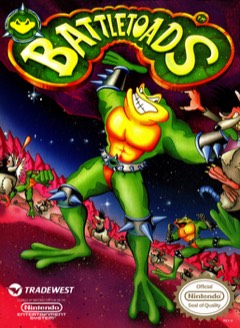
Rare's answer to the Teenage Mutant Ninja Turtles craze: three muscle-bound space toads, two of whom, Rash and Zitz, go to Ragnarok's World to rescue their friend Pimple and Princess Angelica from the Dark Queen. It opens as a beat 'em up, with fists that swell to cartoon size on the final blow and boots that sprout into giant ones.
Then it keeps changing. Level two lowers you down a crater on a cable. Level three, the Turbo Tunnel, puts you on a speeder bike dodging walls that come faster and faster. After that you surf, climb, fly, race a rat down a tower, ride a unicycle through a maze, and hop across giant snakes. Across twelve stages, almost no two play alike. There are no passwords and no saves, only continues.
Where it sits in history
Tim and Chris Stamper built it at Rare, with artist Kevin Bayliss designing the characters, and Tradewest published it on the NES in North America in June 1991. A Famicom version followed in Japan, slightly easier, and Europe got it in 1993. Rare made it deliberately hard to stretch its life; Bayliss has said even the programmer who built the levels would scream at them.
It won seven categories at the 1991 Nintendo Power Awards and sat near the top of the magazine's charts for well over a year, kept off number one only by Super Mario Bros. 3. It sold around 1.25 million NES cartridges in the US by September 1992 and launched a series.
How it plays today
The presentation is still a treat. The animation is lively, the music bangs, and the first stage is a genuinely great beat 'em up with a clever boss fight from the enemy's viewpoint. Every new level is a surprise, and there is real satisfaction in finally clearing a stage that beat you twenty times.
But the reputation is earned. The Turbo Tunnel and the later vehicle stages are pure memorisation, where one mistimed jump sends you back, and some platforming deaths come from hit detection rather than your own error. Three lives per continue and no way to save make every attempt a long one. Most people will want the modern re-releases' conveniences.
Compared with
Why it matters
There is a particular silence in a room after someone crashes in the Turbo Tunnel for the twentieth time. Then somebody reaches for the controller again. Rare made Battletoads hard on purpose, so hard its own programmer screamed at the levels, and players took that as an invitation.
Albert Camus ended his essay on Sisyphus, condemned to roll a rock uphill forever, with 'One must imagine Sisyphus happy.' Meaning, for Camus, lives in the struggle itself. Jesper Juul's paradox of failure fills in the rest: we dodge failure in life but seek it in games, because failing makes us reconsider and improve. The Turbo Tunnel is a rock with a speeder bike on it. Each run is a little less bad, until one isn't bad at all. Then the next stage changes the rules and the rock rolls back down. Ask anyone who finally reached the end how they feel about it now.
Read: One must imagine Mario happy →
- Camus, A. (1942). The Myth of Sisyphus.
- Juul, J. (2013). The Art of Failure: An Essay on the Pain of Playing Video Games. MIT Press.
What you're levelling up
You have been training these without noticing. Here is how to do it on purpose, and where it pays off away from the couch. All the skills games teach →
Memory and routing
In the game. The Turbo Tunnel and later vehicle stages are pure memorisation. One mistimed jump sends you back.
Do it on purpose. Write the Turbo Tunnel's walls down from memory, then play it and see what you missed.
Off the couch. Remembering what someone told you, the name of their dog, the gig they mentioned, is a cheat code for being liked.
Bouncing back
In the game. No passwords, no saves, three lives per continue. Clearing a stage that beat you twenty times is the reward.
Do it on purpose. Pick one stage and count attempts. Each time, name the exact moment it went wrong.
Off the couch. Getting turned down doesn't have to wreck your week. Shrug, learn something, go again. Same goes for job applications.
Keeping your cool
In the game. The walls come faster and faster in the Turbo Tunnel. Tense up and you're done.
Do it on purpose. When you feel your grip tighten, loosen your thumbs on purpose and breathe out before the next wall.
Off the couch. A flat tyre on the freeway, a tough call at work, the first quiet moment on a date. Whoever stays level gets to think.
Verdict · 7/10
Gorgeous, inventive and punishing to the point of cruelty. Play it for the variety, and do not feel bad about using every help you can get.