What it was
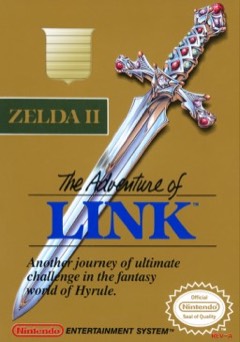
Nintendo's first Zelda sequel threw out most of the first game. Hyrule is now an overhead map you cross between towns, caves and palaces, and the moment you step into one of them, or a monster catches you on the road, the view drops to the side and the fight is face to face.
Those fights are the heart of it. Link blocks high or low, jumps, and later learns to stab downward and upward. Armoured knights shift their shields to match your stance, so every duel is a small reading contest. Defeating enemies earns experience you spend on attack, magic or life. Eight spells, taught by wise men in eight towns, take the place of the first game's items; the Life spell is your main way to heal. Six palaces wait for the crystals Link must return before he can reach the Great Palace and wake the sleeping Zelda.
Where it sits in history
It came out on the Famicom Disk System on 14 January 1987, less than a year after the original. Shigeru Miyamoto produced and Takashi Tezuka wrote the story, but a new team made it, directed by Tadashi Sugiyama and Yasuhisa Yamamura. The combat drew on Kung-Fu Master and the levelling on Dragon Quest.
A ROM chip shortage pushed the NES version back to late 1988: 26 September in PAL regions and 1 December in North America. It sold out at many shops that year, won Nintendo Power's game of the year and reached 4.38 million copies. Its magic meter, its Dark Link and the Triforce of Courage stayed in the series. Its lives and experience points never came back.
How it plays today
The swordplay has aged better than almost anything else on the NES. Once you learn the rhythm of the crouching stab and the jumping strike, the duels with the armoured knights are tense and fair, and beating one feels earned. The palaces are long, moody and well built.
The rest has sharp edges. Healing fairies are rare, lives run out, and a game over costs you ground. Some townsfolk give clues so vague you will want a guide, and the Great Palace at the end is punishing. Level up generously before each palace and the game becomes firm rather than cruel.
Compared with
- The Legend of Zelda: The original is open and overhead; the sequel is narrower, harder and far more about the fight in front of you.
- Castlevania II: Simon's Quest: The closest cousin: a side-scrolling action game with towns, levels and secrets, from the same era.
- Faxanadu: One of several NES games that followed its mix of platforming and RPG systems.
- The Battle of Olympus: Another NES game built directly on the Zelda II template.
Why it matters
The armoured knights in Zelda II watch your shield. Crouch and they lower theirs; stand and they raise it. Every duel becomes a quick conversation in stances, and when it goes right, the room seems to go quiet around it.
That quiet has a name. Mihaly Csikszentmihalyi called it flow: the absorption that comes when challenge matches skill, the goal is clear and feedback is immediate. Self-consciousness drops away and time bends. Zelda II's sword fights hit every mark. The goal is one knight. The feedback is a clang or a hit, instantly. The challenge rises about as fast as you master the crouching stab. The rest of the game shows the other side. Vague clues and scarce lives drag you out of that state and back into worrying. Flow is fragile, and it needs a fair fight. Perhaps that is why players who gave up on Zelda II years ago still talk about those duels. For a few seconds at a time, everything was fair.
Read: The zone: why good games make time disappear →
- Csikszentmihalyi, M. (1990). Flow: The Psychology of Optimal Experience.
What you're levelling up
You have been training these without noticing. Here is how to do it on purpose, and where it pays off away from the couch. All the skills games teach →
Reading people
In the game. Armoured knights shift their shields to match your stance, so every duel is a small reading contest. High or low, and he's watching you too.
Do it on purpose. Against the next knight, feint high twice before striking low. Watch what his shield does.
Off the couch. Good conversation works like that duel: notice how your date responds, adjust, don't just charge. Paying attention is the attractive bit.
Timing and rhythm
In the game. Once you learn the rhythm of the crouching stab and the jumping strike, the duels with the armoured knights turn tense and fair.
Do it on purpose. Pick one enemy and beat it with only crouching stabs. Count the hits you take and get it lower.
Off the couch. Sport, music and comedic timing run on the same beat. Get it into your body and you look relaxed.
Planning ahead
In the game. Healing fairies are rare, lives run out and a game over costs you ground. Level up generously before each palace and the game turns firm rather than cruel.
Do it on purpose. Before the next palace, decide what your experience goes on: attack, magic or life. At the boss, check whether you chose right.
Off the couch. Preparing before the hard bit, studying before the exam, saving before Christmas, turns life from cruel to firm.
Verdict · 7/10
The odd one out in Zelda, with some of the best sword fighting on the NES under its rough edges. Worth playing on its own terms.