What it was
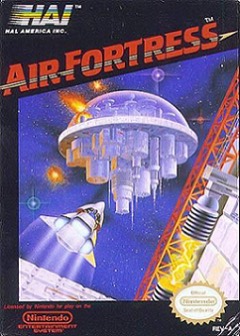
Alien machines called Air Fortresses are eating their way across the galaxy like locusts. The Space Federation sends its best fleet and loses it. So it sends one man, Hal Bailman, in a shielded suit with a small ship, to get inside each fortress and wreck it from within.
Each fortress is two games in a row. First comes the Air Base, a scrolling shooter where you dodge flying enemies and chunks of space station on the way to the Air Lock. You get three attempts, and a single hit kills your ship. Along the way you collect energy and limited-supply crash beam bullets, which you want to save for the second half.
Then you land, and it turns into an action-adventure. You walk a maze, shoot robots, security devices and astronauts, find the central core and blow it. The fortress explodes soon after, and you get a short window to find your ship. The exit is never where you came in.
Where it sits in history
HAL Laboratory developed and published it for the NES. It came out in Japan in August 1987. North America got it in September 1989, after a test release of just 385 copies in 1987, and Australia got it in 1989 too.
Director, designer and programmer Hiroaki Suga left his name in the game: SUGA is the password for the final fortress. HAL America sold it by mail order through a national ad campaign, and buyers got a free Air Fortress T-shirt. One small difference between regions: in the Japanese version a hit in the lightship sends you back to the start of the approach, while the American version respawns you where you died if you have lives left.
How it plays today
Critics split on it when it came out. VideoGames & Computer Entertainment praised the mix of arcade and adventure but found the music repetitive. Computer Entertainer liked the visuals but said the difficulty climbs fast after the first fortress and the shooting parts are the duller half. Later reviews are just as split.
It is a strange cartridge, and that is the appeal. The maze with a countdown is the tense bit: you blow the core, the clock starts, and you realise you have no idea where the exit is. If you like being thrown into a place and made to work it out, this is for you. If you want the shooter to carry the game, it will let you down.
Compared with
- Metroid: Also a maze of rooms to explore and escape from, with far more room to roam.
- Life Force: All shooter, no getting out of the ship: if the Air Base half is your favourite, go here.
- Kid Icarus: Another NES game where you explore and fight at your own pace.
Why it matters
Air Fortress asks you to switch modes mid-game. You go from reflexes in a ship to finding your way on foot, then back to a race against a clock you cannot slow down. Each skill has to come off the shelf at the right time.
Csikszentmihalyi describes flow as challenge matched to skill, with clear goals and fast feedback. The goal here is clear (reach the core, then get out) and the feedback is immediate, but the exit is never where you came in, so every fortress is a fresh problem. It is a good lesson in staying calm when the map is new.
Read: The zone: why good games make time disappear →
- Csikszentmihalyi, M. (1990). Flow: The Psychology of Optimal Experience.
What you're levelling up
You have been training these without noticing. Here is how to do it on purpose, and where it pays off away from the couch. All the skills games teach →
Keeping your cool
In the game. Once the core goes up, the fortress explodes soon after and you only have a short window to find your ship.
Do it on purpose. Next time the clock starts, say your route out loud before you move. Panicked wandering costs more seconds than a plan does.
Off the couch. Deadlines, a missed train, a tense meeting. Slow your breathing and the options get clearer.
Spatial thinking
In the game. The exit is never where you entered, so you build a mental map of the maze as you go.
Do it on purpose. Sketch one fortress on paper after a run. Compare it with the next attempt.
Off the couch. Finding your way out of a strange building or city without pulling out your phone. Your mates will think you are a legend.
Planning ahead
In the game. Crash beam bullets are limited, and you collect them in the shooter half to use in the fortress. Waste them early and the maze is harder.
Do it on purpose. Play one fortress holding your crash beam for the maze only. Note how it changes the fight.
Off the couch. Saving something for when it matters, whether that is cash, energy or a good story.
Verdict · 6/10
An odd two-in-one that never quite masters either half. The escape from an exploding fortress is the part you will remember.