What it was
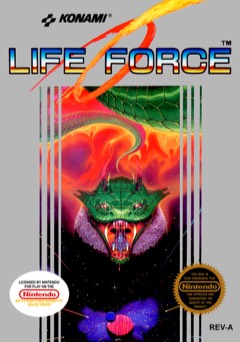
Life Force is the NES version of Salamander, Konami's 1986 arcade spin-off from Gradius. One player flies the Vic Viper; a second can join at the same time in the Lord British. Stages switch between scrolling left to right and scrolling upwards, which no Gradius game had done.
The NES game is a mix. It takes from both the arcade Salamander and Konami's later Japanese arcade re-release called Life Force, which redrew everything as flesh and bone. Some levels and bosses were cut and new ones added. In place of the arcade's instant pick-ups it uses the Gradius power bar: collect capsules, then choose when to spend them on speed, missiles, lasers, options and a shield.
Where it sits in history
The Famicom version came out in Japan in 1987 and the NES version in North America in 1988. It is nearly the same game, minus the Famicom's multiple endings, and with two options instead of three. Europe got it on 22 November 1989 as Life Force: Salamander. Nintendo Power covered its first two levels in its second issue in 1988, then went back for the whole game.
The Konami Code works here too, and lifts your lives from three to 30. In 1997 Electronic Gaming Monthly ranked it the 76th best console game of all time, calling it one of the first big two-player simultaneous shooters on the NES and singling out the fire stage. It returned on the Virtual Console for Wii in 2009, the 3DS in January 2014 and the Wii U in August 2014.
How it plays today
Very well, especially with two. Sharing a screen with a friend changes a shooter: you split the work, you steal each other's capsules, and you cover the side the other one is not watching.
The switch to vertical stages keeps it fresh across a short run, and the fire stage is still a show. Alone it is a solid Gradius-style game; with a partner and the Konami Code it is one of the best evenings on the system.
Compared with
- Gradius: The game Life Force spins off from, one player only and always sideways.
- Gradius III: Konami's next big step for the power bar, on the SNES.
- Contra: Konami's other great two-player NES game, on foot instead of in a ship.
Why it matters
Erving Goffman wrote that a game builds a shared world with its own rules about what matters, and that being absorbed in it together is what makes an encounter feel alive. Life Force is a good small proof. Alone, it is a test of reflexes. With someone beside you on the couch, the same stages become something you two did.
Nobody remembers their high score from 1988. People remember who held the other controller.
Read: The second controller →
- Goffman, E. (1961). Encounters: Two Studies in the Sociology of Interaction ('Fun in Games').
What you're levelling up
You have been training these without noticing. Here is how to do it on purpose, and where it pays off away from the couch. All the skills games teach →
Teamwork
In the game. Two players share the screen, one in the Vic Viper and one in the Lord British. You split the work and cover the side the other isn't watching.
Do it on purpose. Before the next stage, agree who covers top and who covers bottom. Stick to it and see how far you get.
Off the couch. Two people with clear jobs beat two people doing everything. Works on a building site, in a kitchen and in a share house.
Judging risk
In the game. The Gradius power bar makes you choose when to spend capsules: speed, missiles, lasers, options or a shield. Spend early and you're fragile; hoard and you're slow.
Do it on purpose. Play a run where you call your power-up choice out loud before you take it, and say why. Notice which picks get you killed.
Off the couch. Money is a power bar. Spend on the thing that keeps you alive first, then the fun stuff.
Winning and losing well
In the game. With a friend you'll steal each other's capsules. It's part of the fun, and it can turn a good evening sour.
Do it on purpose. Next co-op run, offer your mate the first laser capsule. See if the game goes better.
Off the couch. Letting someone else have the win is an underrated move. Mates notice, and so does anyone you're trying to impress.
Verdict · 8/10
A Gradius you can share. Bring a friend, enter the code, and fly into the fire stage together.