What it was
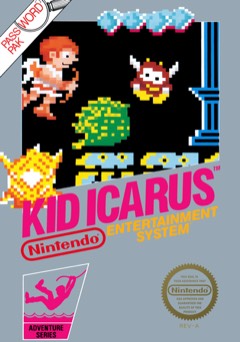
Pit, a young angel imprisoned in the Underworld, gets a bow from the captured goddess Palutena and must climb out, cross the surface and reach the sky to rescue her from Medusa in the Greek-flavoured Angel Land. It is a platformer with a role-playing streak: defeated enemies drop hearts, which you spend in shops and black markets, and your score at the end of each level decides whether your health bar grows.
The levels are unusual for 1986. The Underworld and Skyworld stages scroll upwards as you climb, with the screen wrapping from one side to the other; the surface world scrolls sideways. Each world ends in a fortress, a maze of fixed rooms where you can buy a map sheet, pencil and torch to find your way to the boss. Beat all three and the final stage turns into a shooter. Along the way, doors lead to shops, hot springs, treasure rooms and chambers that test you for power-ups.
Where it sits in history
Nintendo's R&D1 made it, the same team that had just finished Metroid. Toru Osawa, in his first job as a designer, started it alone from his love of Greek myth; Yoshio Sakamoto joined after Metroid and shaped much of the design, Satoru Okada directed, Gunpei Yokoi produced and Hirokazu Tanaka wrote the music. The team slept on cardboard in an unheated office to hit a December 1986 release on the Famicom Disk System, finishing three days before launch.
The NES cartridge followed in Europe in February 1987 and North America that July, replacing disk saves with a password system, which was rare at the time. It sold 1.76 million copies by late 2003, earned a cult following, and gave us Pit, who returned years later in Super Smash Bros. Brawl and Kid Icarus: Uprising.
How it plays today
Unevenly. The music is excellent and the idea of a platformer with shops, upgrades and mazes is still appealing. The surface world and the fortresses have real character, and the jokes, such as a wizard who turns Pit into an eggplant, show a playful team at work.
The trouble is the first world. Pit starts weak, the climbing stages punish every missed jump as the screen scrolls away beneath you, and the enemies are relentless. Pit's bow and health grow as you play, so the game feels hardest exactly when you are least equipped for it. The dark backgrounds and small sprites also show their age. Push past the Underworld and it becomes a much better game.
Compared with
- Metroid: The sister game from the same team; more atmospheric and open, where Kid Icarus is linear and full of shops and jokes.
- Castlevania: Another 1986 action platformer that starts hard, but its difficulty is fairer and its controls tighter.
- Mega Man 2: A later NES game that shows how to build difficulty without front-loading it.
Why it matters
Kid Icarus climbs from the Underworld to the sky, a route Greek storytellers would have recognised. Toru Osawa started it alone out of love for those myths, and the team finished it sleeping on cardboard in an unheated office. Somewhere in that crunch, somebody still made time for a wizard who turns Pit into an eggplant.
That joke matters more than it looks. Jaak Panksepp and Jeff Burgdorf found that rats make ultrasonic 'laughter' when tickled and seek out play: play and joy run deep in mammals. Johan Huizinga argued play is older than culture itself. Put them together and the eggplant wizard is no distraction from serious work. It is the oldest part of the job. Creatures were playing long before anyone wrote down a myth, and the urge to be silly survived the cardboard, the deadline and the three days to spare. The first world is brutal. Push through anyway. A playful team is waiting on the other side.
Read: Older than us: play before people →
- Panksepp, J., & Burgdorf, J. (2003). 'Laughing' rats and the evolutionary antecedents of human joy? Physiology & Behavior, 79(3), 533-547. doi:10.1016/S0031-9384(03)00159-8
- Huizinga, J. (1938/1949). Homo Ludens: A Study of the Play-Element in Culture.
What you're levelling up
You have been training these without noticing. Here is how to do it on purpose, and where it pays off away from the couch. All the skills games teach →
Bouncing back
In the game. The first world is the hardest part. Pit starts weak, the climbing stages punish every missed jump as the screen scrolls away beneath you, and the enemies are relentless.
Do it on purpose. Mark how far up the Underworld you get each try. Beat your mark every session until you're out.
Off the couch. The start is always the hardest bit: the first month at the gym, a new job, putting yourself out there again after a break-up. Push past the Underworld and it gets better.
Spatial thinking
In the game. Each world ends in a fortress, a maze of fixed rooms, where you can buy a map sheet, pencil and torch to find the boss. The climbing stages wrap from one side of the screen to the other.
Do it on purpose. Try a fortress without the map sheet. Draw it on paper as you go and compare with the game's map afterwards.
Off the couch. Finding your way round a new campus or a hospital you've never been in. Keep the map in your head and you're the one who knows where the lifts are.
Judging risk
In the game. Defeated enemies drop hearts you spend in shops and black markets, and your score at the end of each level decides whether your health bar grows.
Do it on purpose. Pick a rule for one world: buy only once you've saved a set number of hearts. See whether you come out stronger.
Off the couch. Small buys add up. Pick a rule for impulse spending and see what's left at the end of the month.
Verdict · 6/10
A charming, odd and front-loaded platformer with great music. Worth playing once you get through its brutal opening world.