What it was
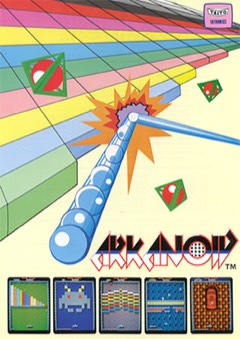
Arkanoid is Breakout with ambition. You steer a little ship called the Vaus along the bottom of the screen, bounce a ball into a wall of coloured bricks and clear the lot to move on. Some bricks take two hits. Some can't be broken at all. Some drop capsules you catch for power-ups: a longer Vaus, a slower ball, an extra life, cannons.
Floating enemies drift in and can be shot for bonus points. The NES version runs for 36 stages, then puts you up against DOH, and once you reach him there are no continues. Win and time runs backwards, the ship is whole again, and the game tells you this isn't the last you'll see of him.
Where it sits in history
Taito built it in 1986. Akira Fujita and Hiroshi Tsujino from Taito's Yokohama Research Institute won an internal contest to design a new block breaker, then were told to merge their ideas. Tsujino has called the schedule murderous, and location tests started a month after development did. The neon look came from Tsujino being a big fan of Tron, and the music is by Hisayoshi Ogura of Zuntata, Taito's house band.
The Famicom version came out in Japan on 26 December 1986 and the NES version in North America in August 1987. The NES version was packaged with a custom paddle controller. Computer Gaming World named the NES port the best arcade translation for the console in 1988, and in 1997 Electronic Gaming Monthly ranked it the 41st best console game ever.
How it plays today
It's still a hypnotic little thing. The loop is dead simple: don't drop the ball. But the power-ups keep changing the maths. Catch the wrong capsule at the wrong time and your plan goes with it.
The catch is the paddle. The NES game was built around its custom controller, and a d-pad is a clumsy way to play it. Still, the lasers feel good, and EGM got it right: you pick it up for a quick fix and look up an hour later.
Compared with
- Breakout: The 1976 Atari game it set out to improve on.
- Tetris: The other NES game where one simple rule and a rising speed eat your whole evening.
- Kirby's Dream Course: A different take on aiming a bouncing ball.
Why it matters
Csikszentmihalyi's flow is about being so absorbed that you lose track of yourself, with clear goals and instant feedback. Arkanoid is a clean example: one goal, one ball, and the result of every move shows up half a second later.
That's why it eats hours. Nothing in it asks you to think about who you are, only where the ball will be.
Read: The zone: why good games make time disappear →
- Csikszentmihalyi, M. (1990). Flow: The Psychology of Optimal Experience.
What you're levelling up
You have been training these without noticing. Here is how to do it on purpose, and where it pays off away from the couch. All the skills games teach →
Timing and rhythm
In the game. You meet the ball with the Vaus at the right moment, over and over, with the ball slowing or the Vaus stretching if you've caught the right capsule.
Do it on purpose. Pick a spot on the Vaus and try to hit the ball with it every time.
Off the couch. Getting a word in at a loud dinner table: wait for the gap, then go, not halfway through someone's punchline.
Hand-eye coordination
In the game. You keep the Vaus under a ball that's always in motion, and the NES came with a paddle controller for it.
Do it on purpose. Play a stage with the ball slowed down, then without, and notice what your hands do.
Off the couch. Catching a set of keys somebody tosses at you across the car park.
Planning ahead
In the game. A capsule falls toward you and you choose whether to catch it, because the wrong power-up can wreck your setup.
Do it on purpose. Before each capsule, decide whether you want it, not just whether you can reach it.
Off the couch. Saying no to the shiny extra shift or side project that would wreck the week you'd planned.
Verdict · 8/10
A genre in one cartridge: simple, fast and hard to put down. Better with the paddle than without.