What it was
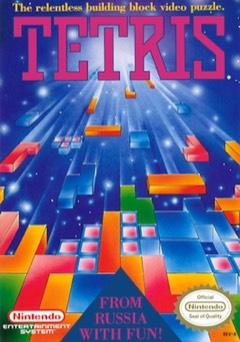
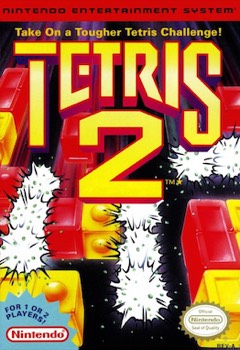
Seven shapes fall into a well; you turn and slide them to complete rows. Nintendo's NES version offers two modes. A-Type is the endless climb for points, faster every ten lines. B-Type sets a fixed speed, fills the bottom with junk, and asks you to clear 25 lines. A preview box shows the next piece, and a side panel counts how many of each shape you have seen, which becomes grimly funny during a long drought of straight pieces.
Scoring is what shapes the whole game. Clearing four rows at once, a tetris, pays several times more per line than smaller clears, and every clear is multiplied by your level. So the best play is greedy: stack high, leave one column open, and wait for the long bar.
Where it sits in history
Alexey Pajitnov's puzzle reached the NES in 1989 by way of a licensing fight. Soviet agency ELORG signed international console rights to Nintendo, which left Atari Games and its Tengen label holding a cartridge they had no right to sell. Tengen's version was pulled from shelves, and American reviewers of the day mostly preferred it to Nintendo's. Pajitnov gets the concept credit but did not work on this port, and the music swaps the Game Boy's Korobeiniki for Tchaikovsky and Bizet.
It sold 1.5 million copies in its first six months and 8 million by 2004. The second life came decades later. Speed tops out at level 29, a pace the designers plainly thought nobody could survive; the level counter even breaks past it. Players answered with hypertapping, then in 2020 rolling, a way of drumming the controller from behind. In December 2023 Willis Gibson, aged 13, pushed so far that the game crashed, the first time anyone had been credited with beating it.
How it plays today
The core is as pure as puzzle games get, and this version's quirks give it a flavour of its own. It offers few comforts beyond the next-piece box, so every placement feels like a commitment. The early levels are relaxing; by level 18 or 19 the tension is real, and the scoring means you are constantly weighing a safe clear against a big payoff.
The rough edges are real too. Sideways movement is slow unless you learn a fast technique, pieces are random with no protection against droughts, and there is no two-player mode, though one sits unfinished in the code. As a casual pick-up game later versions are friendlier. As a test of skill with a clear ceiling to chase, NES Tetris is hard to beat, which is why the Classic Tetris World Championship still plays it.
Compared with
- Dr. Mario: Nintendo's other NES falling-block puzzle, and just as easy to lose an evening to.
- Mike Tyson's Punch-Out!!: Another NES game about learning patterns until your hands know them before your head does.
- Tetris & Dr. Mario: The 1994 SNES pairing that remakes this Tetris with 16-bit visuals.
Why it matters
Ask anyone who has played Tetris late at night where the hours went. Mihaly Csikszentmihalyi called it flow: absorption that arrives when challenge matches skill, goals are clear and feedback is immediate. Self-consciousness falls away and time bends. Tetris may be the purest machine for it ever built. Seven shapes, one well, and every drop tells you at once how you did.
The NES version adds a twist. Its speed keeps climbing, so the challenge rises with you, until level 29, a pace its designers plainly thought nobody could survive. Then players kept getting better. Hypertapping, then rolling, then in December 2023 Willis Gibson, aged 13, playing until the game itself gave out. That is the human part. Give people a ceiling and they will spend decades learning to climb past it, together, at a world championship, over a puzzle about tidying up.
Read: The zone: why good games make time disappear →
- Csikszentmihalyi, M. (1990). Flow: The Psychology of Optimal Experience.
What you're levelling up
You have been training these without noticing. Here is how to do it on purpose, and where it pays off away from the couch. All the skills games teach →
Judging risk
In the game. A tetris pays several times more per line, so the best play is greedy: stack high, leave a column open and wait for the long bar. Then a drought hits.
Do it on purpose. Set a height rule: once the stack passes a line you pick, take any safe clear. Shift the line up or down across sessions and watch your scores.
Off the couch. Greedy works until it doesn't. Know your bail-out point before you start, with money, a big night or a job you're unsure of.
Deep focus
In the game. The early levels are relaxing; by 18 or 19 the tension is real and every placement is a commitment.
Do it on purpose. One hour, phone out of the room, A-Type. Note the level where your mind starts wandering, and push past it next time.
Off the couch. Dropping into one thing and staying there gets exams and deadlines done. Give someone that same attention over dinner and it's attractive.
Spatial thinking
In the game. Seven shapes, one open column, and a next-piece box giving you one move of warning. You're turning pieces in your head before they hit the board.
Do it on purpose. For a session, decide where the next piece goes while the current one is still falling. Count how often you had to change your mind.
Off the couch. Seeing how things fit helps packing a car, laying out a room and reading a map. Being the one who knows how it goes together is quietly handy.
Verdict · 9/10
A near-perfect puzzle wrapped in a port with some real quirks, which its players turned into strengths. Few NES games still have a live world championship.