What it was
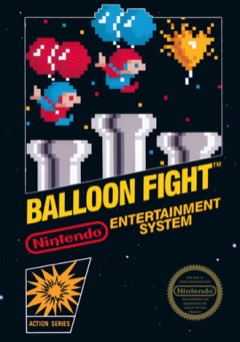
Two balloons, one helmet, a lot of flapping. Your Balloon Fighter rises when you tap or hold a button and drifts when you stop, and the aim is to pop enemy balloons from above while keeping your own. Knock an enemy into the water and a bubble rises for bonus points; lose both of your balloons, drop into the sea or float too low and a giant fish swallows you whole. Lightning adds another hazard, and every third round is a bonus stage of balloons rising from chimneys.
The second mode is the one people remember. Balloon Trip scrolls sideways forever through a field of sparks. You have one life, you collect loose balloons for points, and you see how far you get. It is simple and very hard to put down.
Where it sits in history
Nintendo and HAL Laboratory made it, first for arcades as VS. Balloon Fight and then for the Famicom in Japan in 1985, with the NES version reaching the West in 1986. The arcade machine has different, vertically scrolling layouts and no Balloon Trip; that mode was added for the home version. The debt to Williams' 1982 arcade game Joust is plain, but the floaty physics give it its own feel.
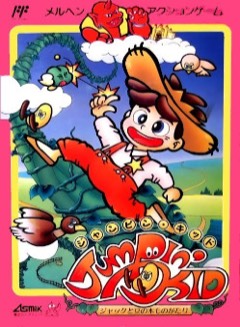
It never had a big sequel on home consoles, but it has echoed through Nintendo's catalogue ever since: a Game & Watch version built on Balloon Trip, the Game Boy's Balloon Kid, a DS remake starring Tingle, a stage in Super Smash Bros., and Balloon Trip Breeze in Nintendo Land.
How it plays today
The flight model is the draw, and it still works. Your fighter carries momentum, so you learn to feather the button and drift into position rather than steer directly, and a well-timed swoop onto an enemy's balloons feels great. Two players at once, co-operating or getting in each other's way, is better still.
There is not much else. The main mode cycles through a small set of screen layouts with more enemies each time, and after twenty minutes you have seen it all. The fish and the lightning give it some bite, but it is a score-chaser from 1985 and plays like one. Balloon Trip is where the lasting value sits: a clean, endless test that works in five-minute bursts.
Compared with
- Joust: The obvious inspiration, with flying mounts instead of balloons; its NES port arrived two years after this one.
- Mario Bros.: Another single-screen Nintendo arcade game built for two players, one of whom will always knock the other into trouble.
- Ice Climber: Another early Nintendo game that is at its best with a friend on the second pad.
Why it matters
Balloon Fight is barely about anything. You flap, you drift, you bump someone from above, and a fish eats whoever sinks too low. It is closer to a playground than a sport, and that is its charm. Roger Caillois sorted play into kinds, and one he called ilinx: the play of vertigo, of spinning and falling for the feel of it. Balloon Trip, drifting forever through sparks on one life, is ilinx with a score attached.
The urge underneath is older than us. Jaak Panksepp and Jeff Burgdorf found rats make ultrasonic 'laughter' when tickled and seek out play; play and joy run deep in mammals. Two siblings on a couch, popping each other's balloons and shrieking, are doing something animals did long before there were couches. Nintendo has kept Balloon Trip alive ever since, from Game & Watch to Nintendo Land, perhaps because nobody quite outgrows it.
Read: Older than us: play before people →
- Caillois, R. (1958/1961). Man, Play and Games (trans. M. Barash).
- Panksepp, J., & Burgdorf, J. (2003). 'Laughing' rats and the evolutionary antecedents of human joy? Physiology & Behavior, 79(3), 533-547. doi:10.1016/S0031-9384(03)00159-8
What you're levelling up
You have been training these without noticing. Here is how to do it on purpose, and where it pays off away from the couch. All the skills games teach →
Hand-eye coordination
In the game. Your fighter carries momentum, so you feather the button and drift into position rather than steer. A well-timed swoop onto an enemy's balloons feels great.
Do it on purpose. Play one round with a rule: no holding the button. Taps only, and count how many clean swoops you land.
Off the couch. Small physical competence, sport, cooking, catching a falling glass, reads as confidence. Confidence is attractive.
Deep focus
In the game. Balloon Trip scrolls forever through sparks with one life. It's simple and very hard to put down.
Do it on purpose. Five-minute Balloon Trip runs, phone away. Notice what your head's doing on your best run.
Off the couch. Study, training, learning guitar. Getting into the zone on purpose is close to a superpower when everything's built to distract you.
Teamwork
In the game. Two players at once, co-operating or getting in each other's way. Bumping your mate into the fish is easy; covering for him is the skill.
Do it on purpose. Play co-op and call every swoop out loud: 'I've got left'. Talk more than feels natural.
Off the couch. Share houses, footy teams, relationships. The person who calls their position and doesn't blame the other player is the one people want next to them.
Verdict · 7/10
A charming arcade game with a flying feel that still works, and a Balloon Trip mode worth the price alone. Best in short bursts and best with two.