What it was
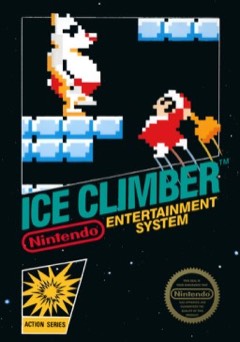
Popo in blue and Nana in pink climb 32 ice-covered mountains to take back vegetables a giant condor has stolen. Each mountain is eight layers of ice. You smash a hole in the ceiling with your mallet, jump through, and do it again, while seals or yetis called Topis push blocks of ice back into the holes you made, birds called Nitpickers swoop across several floors at once, and icicles grow under the platforms. Dawdle and a polar bear in sunglasses stomps the ice and pushes the screen up without you.
At the top is a bonus stage with no enemies and a 40-second clock: tricky jumps, moving clouds, the vegetables, and the condor overhead. Grab its feet and you earn the big bonus. Two players can climb together, but the bonus round is a race, and only one of you reaches the bird first.
Where it sits in history
Kenji Miki directed it for Nintendo, and it was the first game Kazuaki Morita programmed. Morita called it a warm-up before he became a main programmer on Super Mario Bros., and he went on to central roles across the Mario and Zelda series and Star Fox 64. It came out in 1985 for the Famicom and for the arcade VS. System, and it was one of the NES launch games in North America.
The arcade version, VS. Ice Climber, is a fuller game: 48 mountains to choose from, wind, blizzards, a bee with a spear, and on its second set of mountains a giant butterfly in place of the condor. Popo and Nana found a second life in Super Smash Bros. Melee in 2001, and returned in Brawl and Ultimate. Finland's former president Mauno Koivisto was reportedly keen on Nintendo games, and his son-in-law has said Ice Climber was his favourite.
How it plays today
The idea is still clever: a platformer where you build your own path upward and the enemies quietly undo it. Breaking the ice feels good, and the first few mountains have an easy rhythm.
The jumping does not. Jumps are stiff and hard to steer, a missed one drops you back down a layer, and if the screen pushes you off the bottom you lose a life. Moving clouds and conveyor ice make it worse. It is best in short bursts, and best of all with a second player, where the frustration turns into shouting and laughing.
Compared with
- Balloon Fight: Another 1985 Nintendo game for two, where the co-op can turn into sabotage at any moment.
- Mario Bros.: An earlier Nintendo game built on two players sharing one screen, where helping and getting in the way are never far apart.
- Kid Icarus: A later NES climb upward, with the same unforgiving fall below you.
Why it matters
Ice Climber asks two people to help each other up a mountain and then, at the very top, to race. You chip holes for each other, wait for the slow one, and then the bonus stage starts and the friendship is suspended for 40 seconds.
Caillois called the play of competition agon, and he saw that it needs a fair, shared starting line. Ice Climber builds the starting line out of cooperation: you only get to compete because you climbed together. It is a small, honest picture of how siblings and friends play, close enough to fight and close enough to make up.
Read: The second controller →
- Caillois, R. (1958/1961). Man, Play and Games (trans. M. Barash).
What you're levelling up
You have been training these without noticing. Here is how to do it on purpose, and where it pays off away from the couch. All the skills games teach →
Teamwork
In the game. Two players climb together, chipping holes for each other while Topis push ice back into the gaps and the polar bear threatens to push the screen up.
Do it on purpose. Climb with a mate and agree who breaks the ceiling and who watches for Topis. Wait for the slow one every floor.
Off the couch. Moving house, a group assignment, a big shift. Wait for the slow one and you all get there.
Winning and losing well
In the game. At the top, the bonus stage is a race against a 40-second clock, and only one of you grabs the condor's feet first.
Do it on purpose. Race your mate for the condor, then climb the next mountain together like nothing happened. Notice if you can't.
Off the couch. Racing your date up the stairs, losing at pool, then laughing about it over a drink. Competitive and good-humoured is a great mix; competitive and sulky isn't.
Bouncing back
In the game. Jumps are stiff and hard to steer, and a missed one drops you back down a layer. Let the screen push you off the bottom and you lose a life.
Do it on purpose. Count how many layers you fall on one mountain. Next go, beat it, and after each fall pick one thing to fix.
Off the couch. Two steps forward, one back is how most goals go: saving, fitness, a new skill. Count it and keep climbing.
Verdict · 6/10
A short, stiff, charming climb that has aged worse than its fame. Play it with a friend, race for the condor, and forgive the jumping.