What it was
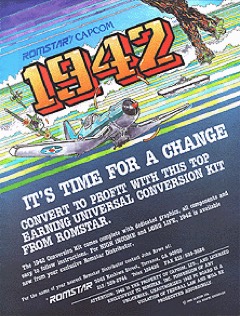
1942 is a vertical shooter set in the Pacific in World War II, loosely based on the Battle of Midway. You fly a Lockheed P-38 Lightning called the Super Ace and shoot down enemy planes while dodging fire. One hit, or a collision, costs a life. Power-ups include two smaller fighters that fly alongside you in a Tip Tow formation. Enemies include Zeros and Kawasaki Ki-61s, and the boss is a Nakajima G10N.
The clever bit is the roll button. Press it and your plane loops out of the playing area for a moment, which gets you out of trouble. The arcade game also kept a second high score, a percentage that records how many of the enemies you actually shot down. It rewards a careful pilot over a lucky one.
Where it sits in history
Yoshiki Okamoto designed the arcade original, released in 1984. It was Capcom's first game made with Western markets in mind, which is why you fly an American plane and the aim is to reach Tokyo. The WWII setting was picked so players would get it at a glance. It was Capcom's breakaway hit, bigger than the three titles before it: Vulgus, Sonson and Pirate Ship Higemaru.
Micronics ported it to the NES, out in Japan in 1985 and North America in 1986. Nintendo also put that version in PlayChoice-10 arcade cabinets. The NES game sold over a million copies worldwide. It started the 194X series, five more games from 1987 to 2000, which sold 1.4 million units as of December 2019 and sit as Capcom's 18th best-selling franchise.
How it plays today
It's a clean, quick shooter. Plane in, bullets out, roll when the screen fills. It rewards patience, and it's easy to see why it hooked people in 1986.
It's short on frills. There's no story to chase and little variety. Fine for a coffee-length session, and the loop button still feels good.
Compared with
- Gradius: Another NES shooter if you want more to chew on.
- Life Force: Konami's shooter that swaps between side-on and top-down stages, for when one direction gets old.
- Top Gun: Also puts you in a fighter, but asks you to land it on a carrier too.
Why it matters
Juul's idea is that we avoid failing in life yet seek it out in games, and that failure makes us reconsider and improve. In 1942 one hit ends a life, so you fail constantly, and each loss shows you exactly where you were sloppy.
The percentage score adds a quieter lesson. It measures how well you shoot, not only how much you shoot. Not many games ask whether you were accurate.
Read: Wanting, not liking: what dopamine really does when you play →
- Juul, J. (2013). The Art of Failure: An Essay on the Pain of Playing Video Games. MIT Press.
What you're levelling up
You have been training these without noticing. Here is how to do it on purpose, and where it pays off away from the couch. All the skills games teach →
Hand-eye coordination
In the game. You steer the P-38 through bullet-filled screens and line up shots at the same time.
Do it on purpose. Play one stage firing only when a target is lined up, no spraying.
Off the couch. Threading a trolley through a packed supermarket on Christmas Eve.
Timing and rhythm
In the game. You save the roll button for the exact second the screen fills, since it only helps for a moment.
Do it on purpose. Don't roll until you're sure you need it. Count how many you wasted.
Off the couch. Saving your one big ask, the shift swap or the lift to the airport, for the day you really need it.
Bouncing back
In the game. One hit costs a life, so you get shot down again and again and fly back in.
Do it on purpose. After a death, name the one mistake before pressing start.
Off the couch. A knock-back at work or a date that went nowhere: name the one thing you'd change, then go again.
Verdict · 7/10
Capcom's first big hit and still a decent short blast. The roll button is the best thing in it.