What it was
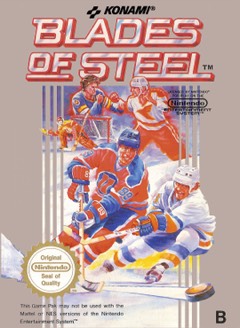
An ice hockey game for one or two players: three forwards, two defencemen and a goalie a side, eight teams from four Canadian and four American cities that had NHL clubs at the time. Play an exhibition, or a tournament run like the playoffs, with the Cup for whoever beats everyone. Against the computer you pick Junior, College or Pro.
Then there is the fighting. Bump the same opponent three times running and the two skaters square up. Mash punches and you might drop him with no penalty; trade punches and a voice yells 'Fight', the screen cuts to a brawl, and each player gets five hits of health, punching and blocking high or low. The loser goes to the box and the other side gets a power play. Fight in front of the net and the referee may award a penalty shot instead, taken from the blue line. Ties go to a five-shot shoot-out.
Where it sits in history
Konami released it in North American arcades in 1987, then brought it to the NES and the Famicom Disk System in 1988; Japan got it as Konamic Ice Hockey. The talking was the talk of it: 'Faceoff', 'Fight', a garbled line after each pass that players still argue about, rare in an NES game. It sold over a million copies.
Critics liked it then and mostly liked the Wii Virtual Console release in 2007. Eurogamer found the players all one model in loud colours. Electronic Gaming Monthly left it out of a best-ever list in favour of Nintendo's Ice Hockey, granting Blades the better graphics but calling Ice Hockey more fun. Konami returned to the name on the Nintendo 64 and PlayStation a decade later.
How it plays today
Well. Skating is quick, passing is crisp, and the voice still lands. The rules are loose (no offside, only fights and icing get called), which suits a game this fast.
The fights are the reason to play. Two people on a couch will start one on purpose inside five minutes, and the penalty box gives the brawl a cost, so it never feels free.
Compared with
- Ice Hockey: Nintendo's 1988 rival: simpler players, and EGM thought it more fun.
- Double Dribble: Konami's NES basketball, which Nintendo Life thought has aged worse.
- Tecmo Bowl: Another two-player sports staple of the same years.
Why it matters
Caillois called competitive play agon. Blades of Steel puts a second, smaller agon inside the first: a fist fight with its own health bar, its own winner, and a price the loser's whole team pays.
That nesting is the joke and the point. Nobody is hurt, everybody knows the rules, and the brawl means something only because the hockey game around it does. It is two friends agreeing, for one evening, to care very much about who wins a fight between little pixel men.
Read: The second controller →
- Caillois, R. (1958/1961). Man, Play and Games (trans. M. Barash).
What you're levelling up
You have been training these without noticing. Here is how to do it on purpose, and where it pays off away from the couch. All the skills games teach →
Judging risk
In the game. Bump the same skater three times and you can drop the gloves. Win and you might get away clean, lose and you're in the box while they get a power play. Start one in front of the net and the ref might hand them a penalty shot.
Do it on purpose. Next game, only start a fight when you've decided it's worth it. Tally fights won against goals conceded on the power play.
Off the couch. Picking your battles at work, in a share house, with your mates. Most arguments cost more than they win. Know which ones are worth having.
Winning and losing well
In the game. Two people on a couch will start a fight on purpose inside five minutes. It's the game you pick when a mate wants to settle something.
Do it on purpose. Lose a shoot-out? Shake hands, say 'good game', call the rematch. Win one? Do the same, no gloating.
Off the couch. Whoever can take a loss with a laugh is the one everyone wants on their footy team, and the one a date wants to bring along to meet their mates.
Teamwork
In the game. Passing is crisp and skating's quick, so a goal usually comes from moving the puck between your three forwards rather than one skater going end to end.
Do it on purpose. Play a period where you must pass at least twice before any shot. Watch what it does to your scoring.
Off the couch. Every workplace has someone who hogs the puck. Be the one who passes, and you'll find people want you on their project.
Verdict · 8/10
Fast hockey with a fight button and a voice that cheers it on. Still the one to pick when a friend wants to settle something.