What it was
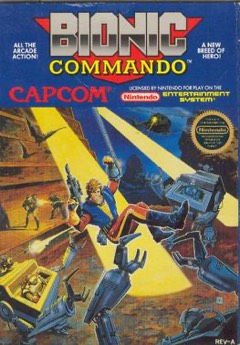
You cannot jump. That is the first thing anyone learns about Bionic Commando, and it changes everything else. Ladd, a soldier in the FF Battalion, carries a mechanical arm that fires a grappling line straight up, straight ahead or at a 45-degree angle. Latch onto a ceiling and you swing; latch onto a ledge and you haul yourself up. Every gap and every climb is solved by the arm.
Between missions you fly a helicopter across an overworld map and pick which area to land in, in any order the paths allow. Enemy convoys move whenever you do, and crossing one drops you into a short top-down shooting stage. On the ground you hunt for communication rooms to tap enemy radio, then fight to the computer room at the end and destroy its core. Some areas are neutral ground where firing a shot sets off the alarm.
Where it sits in history
Capcom released it in 1988, based loosely on its arcade game of the year before. In Japan it was called Hitler's Resurrection: Top Secret, and it meant it: the enemy empire is a neo-Nazi state trying to revive Hitler. The English version renamed the villains the Badds, swapped the swastika insignia for an eagle and called the resurrected leader Master-D, but left his face alone, including the slow-motion frames of his head exploding at the end. The Western release was also rebalanced to make some areas easier.
It did not sell well in Japan, but Nintendo Power put it on the cover of its second issue with an eleven-page feature, and its reputation in the West has only grown. Junko Tamiya wrote much of the music, adapting two of Harumi Fujita's arcade themes and adding new ones. Grin remade it in 2008 as Bionic Commando Rearmed.
How it plays today
The swing is still a delight once it clicks. Chaining grapple to grapple across a pit, letting go at the top of the arc, feels like nothing else on the NES, and it makes old platformer habits useless in a good way. The map adds a light layer of planning, and the equipment you find opens up earlier areas.
The first hour is rough. The arm takes real practice, the early stages don't teach it gently, and the communicator and equipment choices before each drop can lock you out of progress if you pick wrong. The top-down stages are filler. Push through that first hour, though, and it becomes one of the most distinctive action games of its time.
Compared with
- Mega Man 2: Capcom's other 1988 NES game with free stage order, but Bionic Commando swaps the weapon puzzle for movement you have to relearn.
- Contra: Same year, same military setting, completely opposite feel: Contra is all jumping and shooting, Bionic Commando is all swinging.
- Metroid: Both gate progress behind equipment you find along the way, and both reward going back.
Why it matters
You cannot jump. Bionic Commando takes away the most basic verb in platform games and hands you a grappling arm instead, and for the first half hour you fall into a lot of pits. It is easy to quit there. Stay, and the game pays you back.
Jesper Juul describes the paradox of failure: we avoid failing in life yet seek it in games, and failure makes us reconsider and improve. Bionic Commando shows the second half clearly. Every miss teaches the angle and the release point, until grapple chains to grapple and you let go at the top of the arc as if it were nothing. Lev Vygotsky saw play as the place where people stretch just past what they can do. The steep start is that stretch, uncomfortable on purpose. What makes the game quietly wise is the order of events. The failure comes first, and the joy is built out of it. Nobody gets the swing for free, and nobody who learns it forgets the moment it clicked.
Read: One must imagine Mario happy →
- Juul, J. (2013). The Art of Failure: An Essay on the Pain of Playing Video Games. MIT Press.
- Vygotsky, L. S. (1978). Mind in Society: The Development of Higher Psychological Processes.
What you're levelling up
You have been training these without noticing. Here is how to do it on purpose, and where it pays off away from the couch. All the skills games teach →
Spatial thinking
In the game. You can't jump. Every gap and climb is solved with an arm that fires straight up, straight ahead or at 45 degrees. You read each room as angles and anchor points.
Do it on purpose. Before crossing a room, trace your grapple route with your finger on the screen. Then try it in one go.
Off the couch. Flat-pack furniture, packing the ute, finding the car after a gig. Picturing space is the quiet skill everyone leans on when they're lost.
Bouncing back
In the game. The first hour is rough. The arm takes real practice and the early stages don't teach it gently.
Do it on purpose. Give yourself one session just swinging across the first area. No goal but getting the release right.
Off the couch. New job, new sport, new language. The first hour always feels like this. Push through it and it pays you back.
Planning ahead
In the game. Between missions you fly a helicopter across a map and pick where to land, and your communicator and equipment choices can lock you out of progress if you pick wrong.
Do it on purpose. Before each drop, write down what you expect the area needs. Compare after.
Off the couch. Plan the date, not just the time. Somewhere you can actually talk, a backup if it rains. Being the one with a plan is rarer than it should be.
Verdict · 8/10
An original that still has no real equal on the console, held back only by a steep start. Learn the swing and it pays you back many times over.