What it was
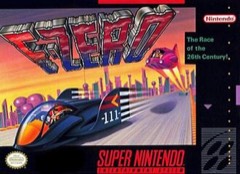
Picture the Super Famicom's first weeks in Japan: a flat track that tilts and turns beneath a hovering car, drawn as if in 3D, at a speed no home console had shown before. That was F-Zero. Nintendo shipped it as a launch game on 21 November 1990, and it existed as much to show off the new hardware as to be a racing game.
The racing itself is simple and strict. You pick one of four hover machines, each driven by a character (Captain Falcon among them), and race five laps against a field of rivals. You must finish each lap in a higher position than a set cut-off or you're disqualified. Every lap you complete earns a Super Jet boost, and you can hold up to three. Crashing into walls, mines or other cars drains your power meter, which refills only in the pit lane on the home straight.
Where it sits in history
Shigeru Miyamoto produced it and Kazunobu Shimizu directed, with a team of nine including three programmers. The trick behind it is Mode 7, a SNES feature that rotates and scales a single flat background layer. F-Zero spins the whole track around your car to fake a 3D road without drawing any polygons. Critics at the time called it the fastest, smoothest pseudo-3D racer on a home system.
North America got it in August 1991 and Europe in 1992. Its 15 tracks come in three leagues, Knight, Queen and King, each with four difficulty levels up to Master. Mute City appears three times, in day, evening and night versions. The series continued with F-Zero X on the Nintendo 64 in 1998.
How it plays today
The sense of speed survives. Hitting a dash plate at full tilt, holding a Super Jet for the last straight and threading between rivals still feels fast and precise, and the music is excellent. On the later leagues, with their tight corners and slippery patches, it becomes a real test of memory and nerve.
What's missing is company. There is no two-player race at all, only a practice mode alongside the championship, and the rivals are either bumpers or rockets. The tracks are flat, since Mode 7 can't do hills. As a solo time-attack game it holds up well; as a racing game to share, it was quickly passed by.
Compared with
- Super Mario Kart: Nintendo's next Mode 7 racer added items, battles and a second player, all things F-Zero lacked.
- Top Gear: A split-screen SNES racer that offers the two-player mode F-Zero never had, at a slower, road-bound pace.
- Excitebike: Nintendo's earlier racer shares the idea of a boost you have to manage, trading heat for a power meter.
Why it matters
There is a moment on a Mute City straight, Super Jet held, dash plate ahead, when your thumbs stop feeling like thumbs. F-Zero was a launch showpiece in 1990, a flat track spun around your car to fake 3D, and the feeling it sells hasn't aged.
Roger Caillois named four kinds of play, and one is ilinx: vertigo. Children spin until they fall over; F-Zero spins the whole world instead. Mihaly Csikszentmihalyi explains why it lasts. Flow comes when challenge matches skill, goals are clear and feedback is immediate; self-consciousness drops away and time bends. The lap cut-off sets the goal. Every wall scrape shows on the power meter at once. The King league raises the challenge as your nerve grows. F-Zero is thin on modes, and mostly it's you against your own lap times. Chasing a tenth of a second alone at night is still one of the purest ways to disappear for a while and come back somehow lighter.
Read: The zone: why good games make time disappear →
- Caillois, R. (1958/1961). Man, Play and Games (trans. M. Barash).
- Csikszentmihalyi, M. (1990). Flow: The Psychology of Optimal Experience.
What you're levelling up
You have been training these without noticing. Here is how to do it on purpose, and where it pays off away from the couch. All the skills games teach →
Judging risk
In the game. Every lap earns a Super Jet and you can hold three. Wall scrapes drain your power meter, which only refills in the pit lane on the home straight.
Do it on purpose. Race Mute City burning every Super Jet the moment you get it. Then race it saving them for the last lap. Compare the times.
Off the couch. Money's the same. Spend every bonus straight away or save a couple for when it counts. Knowing which way you lean is half of being good with cash.
Memory and routing
In the game. The King league throws tight corners and slippery patches at you, and on the harder settings it's a test of memory and nerve.
Do it on purpose. Pick one track and learn where every dash plate and hazard sits. Draw it from memory, then race it and check what you missed.
Off the couch. Names. Learn three people's names at a party, use each one once, and they'll reckon you're the best company there.
Deep focus
In the game. There's no two-player race, so it's you against your own lap times. Super Jet held, dash plate ahead, and your thumbs stop feeling like thumbs.
Do it on purpose. Phone in another room. Ten laps of one track, write down each time, and notice when you drop in and the times start falling.
Off the couch. Full attention is rare. Phone face down, eyes on your date, actually listening: it's the same zone, and they'll notice it.
Verdict · 7/10
A launch game that still feels quick and sharp, even if it is thin on modes. Great for chasing your own lap times; look elsewhere for a night of racing with friends.