What it was
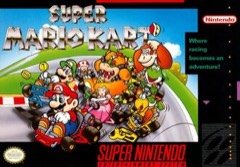
Eight Mario characters, eight go-karts, twenty tracks across four cups, and a pile of items to throw at each other. Grand Prix mode runs five-lap races against seven computer drivers, and you must finish fourth or better or lose a life and race again. Time Trial is just you and the clock. With a friend, you can run the cups together, go one-on-one in Match Race, or fight in Battle Mode, where each kart wears three balloons and the last one with any left wins.
The details are odd by later standards. Coins on the track raise your top speed and soak up hits. The computer drivers have their own special weapons you never get. And the screen is always split, even alone: the bottom half becomes a map.
Where it sits in history
Nintendo EAD built it from a two-player prototype of F-Zero, and the need for two views on one screen is why the tracks are simpler than F-Zero's. Shigeru Miyamoto produced, Tadashi Sugiyama and Hideki Konno directed, and Soyo Oka wrote the music. Mario only arrived a few months in, when someone tried him in a kart and it looked right. The flat, rotating Mode 7 tracks came from F-Zero too.
It launched in Japan on 27 August 1992, in North America a few days later, and in Europe in January 1993, and went on to sell 8.76 million copies, making it one of the SNES's biggest sellers. It is credited with inventing kart racing as a genre and with proving Mario could carry games outside platforming, which opened the door to his sports and party spin-offs.
How it plays today
It is the hardest Mario Kart to love at first and among the most rewarding to master. The karts are twitchy, the tracks are tight and walled, and power sliding and hopping around hairpins take real practice. Computer rivals feel like they cheat because, with their private weapons, they partly do. Battle Mode is still excellent: four small arenas, two players, three balloons each, and nothing to decide it but aim and nerve.
What has aged is the look and the limit. Mode 7 was stunning in 1992 and now looks flat and flickery, and with only two players it misses the four-player chaos later games made standard. Newcomers raised on modern Mario Kart will find it stiff. Give it an evening, though, and the precision starts to feel like a feature rather than a flaw.
Compared with
- F-Zero: The same Mode 7 engine turned into a solo, high-speed race; Super Mario Kart trades pace for weapons and a second player.
- Pilotwings: Another early showcase of Mode 7, used for flight instead of racing, and just as dependent on learning its handling.
- Super Bomberman: The other SNES game that sold people on sitting side by side and ruining each other's day.
Why it matters
Super Mario Kart is two kinds of play wearing one cap. Roger Caillois named them. Agon is competition, won by skill: the clean power slide, the tight line through a hairpin. Alea is chance, decided by luck: whatever item you happen to pick up. Most games choose one. This one blends them, which is why a beginner can still snatch a race and an expert still swears at a banana.
Battle Mode strips it back to something like a playground rule. Three balloons each, a small arena, last one with any left wins. Johan Huizinga saw play as free and bounded, with its own order, and nothing shows it better than two people agreeing, for a few minutes, that a balloon matters more than anything in the world. Then the round ends, it matters not at all, and both of you reach for the rematch.
Read: The magic circle: the world that rules make →
- Caillois, R. (1958/1961). Man, Play and Games (trans. M. Barash).
- Huizinga, J. (1938/1949). Homo Ludens: A Study of the Play-Element in Culture.
What you're levelling up
You have been training these without noticing. Here is how to do it on purpose, and where it pays off away from the couch. All the skills games teach →
Timing and rhythm
In the game. Power sliding and hopping round the hairpins is pure feel. Hop a beat early and you kiss the wall, a beat late and you're off the track.
Do it on purpose. Time Trial, one track, one hairpin. Run ten laps caring only about that corner, then check which lap was fastest and what you did differently.
Off the couch. Same instinct tells you when to land a joke and when to stop talking. Good timing looks like calm, and calm is good company on a date.
Judging risk
In the game. Coins lift your top speed and soak up hits, so every line through a coin cluster is a small bet against the wall.
Do it on purpose. Run one cup grabbing every coin no matter what, then one cup ignoring them. Compare where you finish.
Off the couch. Money's the same: a small edge banked steadily beats one big punt. Know which risks are worth it and mates will ask you before they sign anything.
Winning and losing well
In the game. The computer drivers have weapons you never get, so they partly cheat. In Battle Mode against a mate it's three balloons each and nobody to blame but yourself.
Do it on purpose. Next Battle Mode night, say 'good game' after every round, win or lose, then ask for a rematch on the arena you lost.
Off the couch. How you cop getting done over, by a rival at work or a ref on Saturday, is what people remember. Sulkers stop getting invited.
Verdict · 9/10
The game that started a genre and still its most demanding entry. Play it for Battle Mode and for the satisfaction of a clean power slide.