What it was
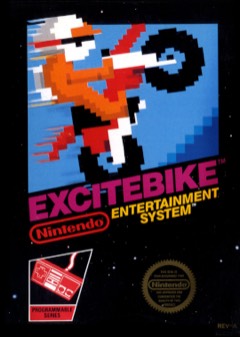
A motocross rider, four lanes and a line of dirt ramps. Excitebike scrolls from left to right while you ride against the clock or against a pack of computer riders, trying to finish third or better to qualify for the championship race.
There are two throttles. A accelerates normally. B is a turbo that goes faster but heats the engine, and if the gauge fills the bike overheats and stops dead while it cools. Riding over arrow markers resets the heat. The D-pad changes lanes on the ground and tilts the bike in the air, and how you land matters: both wheels together keeps your speed, a nose-dive or a wheelie landing costs time or throws you off.
It also came with Design Mode, a track editor with 19 kinds of obstacle. On the Famicom you could save tracks to the Data Recorder tape drive, which never came out elsewhere, so Western players lost their creations when they switched off.
Where it sits in history
Nintendo released Excitebike in 1984, designed and directed by Shigeru Miyamoto. An arcade version, VS. Excitebike, followed on Nintendo's VS. System and became America's second highest-grossing arcade system game of 1985. A 1988 Famicom Disk System release added a head-to-head mode, new music by Soyo Oka and the ability to save tracks to disk.
Its bigger legacy is under the hood. The smooth scrolling engine Miyamoto's team built for Excitebike went into Super Mario Bros. the following year, and it is the reason Mario speeds up from a walk to a run instead of plodding at one pace. The series continued with Excitebike 64, Excite Truck and others.
How it plays today
Surprisingly well, for a game this plain. The heat gauge turns every straight into a small decision, and the landings give the whole thing a physical feel. Learning to clip the top of a ramp and land flat on the downslope is satisfying in a way that plenty of later racers never manage.
What it lacks is variety. The tracks soon blur together, the soundscape is mostly engine noise, and the computer riders are more obstacles than rivals. The editor is fun, but on a Western cartridge with no way to save, it's a toy. In short bursts, it still earns a spot in any NES collection.
Compared with
- Super Mario Bros.: Built on Excitebike's scrolling engine, which gives Mario his run-up and his momentum.
- Mach Rider: Nintendo's other early motorbike game, which swaps side-on dirt for a view from behind the bike.
- F-Zero: Nintendo's SNES racer shares the same trick of a boost that costs you something, just at a far higher speed.
Why it matters
Clip the lip of a ramp, tilt forward, land flat on the downslope, cross an arrow to cool the engine, turbo again. Excitebike is a string of tiny decisions with instant answers, and once it clicks, twenty minutes vanish.
Mihaly Csikszentmihalyi called this flow: absorption when challenge matches skill, with clear goals, immediate feedback, a loss of self-consciousness and a warped sense of time. Excitebike reads almost like a diagram of it. The goal is plain: finish third or better. The feedback is instant: a nose-dive costs time, a flat landing keeps it. The heat gauge keeps the challenge honest, because pure speed overheats you. Design Mode added something else. A child could build a track, ride it and fix it. On Western consoles those tracks vanished when the power went off, which feels fitting. Flow never leaves a record. It exists while you ride, and it's gone the moment you look up.
Read: The zone: why good games make time disappear →
- Csikszentmihalyi, M. (1990). Flow: The Psychology of Optimal Experience.
What you're levelling up
You have been training these without noticing. Here is how to do it on purpose, and where it pays off away from the couch. All the skills games teach →
Judging risk
In the game. B is a turbo that goes faster but heats the engine. Fill the gauge and the bike stops dead while it cools, so every straight is a small bet.
Do it on purpose. Ride one lap all turbo and one lap using the arrow markers to reset the heat. Compare times and work out where the bet pays.
Off the couch. Flogging yourself before a deadline works until you burn out and stop dead. Know where your arrows are, the rest that cools you down, and you go faster overall.
Timing and rhythm
In the game. Land with both wheels together and you keep your speed. Nose-dive or land on a wheelie and you lose time or come off.
Do it on purpose. Pick one ramp and clip the top, tilt and land flat on the downslope ten times in a row. Notice when it stops being luck.
Off the couch. Skating, surfing, a golf swing. Sport is mostly landings, and whoever has the feel for it looks relaxed doing it.
Making things
In the game. Design Mode is a track editor with 19 kinds of obstacle. On a Western cartridge your tracks vanish when you switch off, so build, ride and fix in one sitting.
Do it on purpose. Build a track for a mate with one nasty trick in it, then watch them ride it and fix whatever wasn't fair.
Off the couch. Making something for someone, a playlist, a meal, a track, shows you were thinking about them. That lands better on a date than anything you could buy.
Verdict · 7/10
A small game with a clever heat mechanic and a feel for landings that still hold up. Twenty minutes at a time, it is hard to put down.