What it was
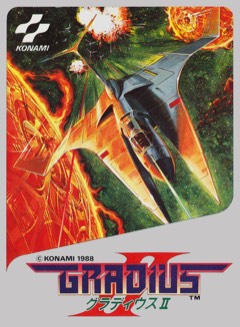
The Vic Viper flies again, this time against the Bacterion Empire under a new leader, Gofer, a giant head. The power meter from Gradius is still there, but before you start you now choose one of four weapon sets, each with its own missile, double and laser. Two of them borrow from Konami's spin-off Salamander, known in the west as Life Force.
It also brought in an idea the series kept: a boss rush, a stage made of nothing but bosses, one after another.
The Famicom version has rules of its own. Take another Option after your fourth and all four circle the ship for 16 seconds. The force field is the only shield, and it takes five hits. Double and Laser each need choosing twice to reach full power.
Where it sits in history
Gradius II began in Japanese arcades in 1988, where it was the country's third highest-grossing arcade game that year; North American arcades knew it as Vulcan Venture. Konami's Famicom port followed on 16 December 1988.
It never left Japan. The usual explanation is the cartridge: it used Konami's own VRC4 chip to improve the graphics and animation, and rebuilding it for a standard NES chip would have been a lot of work when the first Gradius had been less popular overseas. Konami did that work for Castlevania III, but not here.
The Famicom version came to the Wii Virtual Console in Japan in 2007. The arcade original has travelled further: Gradius Collection on PSP in 2006 was its first release outside Japan, and Hamster's Arcade Archives brought it to PlayStation 4 in 2016 and Switch in 2020.
How it plays today
Choosing a weapon set before you fly is a small thing that changes the whole run. You commit to a style, then live with it, and the second time through you choose differently.
It looks and moves remarkably well for a Famicom cartridge; you can see what the extra chip bought. It is hard, like every Gradius, and the boss rush is a wall. If you have a Famicom, it is a cartridge worth owning.
Compared with
- Gradius: The NES original with one fixed weapon path.
- Gradius III: The SNES follow-up, whose Edit Mode lets you mix your own weapon set instead of picking one of four.
- Life Force: The Salamander spin-off whose weapons two of the sets borrow.
- Parodius: Konami's tongue-in-cheek send-up of Gradius: same shooter bones, far sillier ships.
Why it matters
Juul calls it the paradox of failure: we work hard to avoid failing in life, yet we seek it out in games, because failing is what makes us reconsider and get better. Gradius II makes the reconsidering explicit. Lose a run and you are back at the weapon-select screen, choosing again with what the last attempt taught you.
The boss rush is the same lesson, with no stages in between to hide in. You fail, you learn the pattern, you come back. That is not punishment. It is how anyone gets good at anything.
Read: One must imagine Mario happy →
- Juul, J. (2013). The Art of Failure: An Essay on the Pain of Playing Video Games. MIT Press.
What you're levelling up
You have been training these without noticing. Here is how to do it on purpose, and where it pays off away from the couch. All the skills games teach →
Planning ahead
In the game. Before you fly you choose one of four weapon sets, each with its own missile, double and laser. You commit to a style, then live with it.
Do it on purpose. Pick a set and write one line on why it suits you. After the run, write what you'd change, and choose differently next time.
Off the couch. Picking a uni course or a trade is a weapon set. Commit, learn what works, adjust on the next run. No choice is forever.
Bouncing back
In the game. The boss rush is a stage made of nothing but bosses, one after another, and it's a wall. Lose a run and you're back at weapon select.
Do it on purpose. Count your attempts at the boss rush. Each time, name the boss that got you and one thing you'll do differently.
Off the couch. Learning to drive manual, a new sport, a new job. Fail, learn the pattern, come back. That's how anyone gets good at anything.
Pattern recognition
In the game. With no stages between them, the boss rush leaves you nothing but patterns. Each boss runs a script, and once you see it you're dodging early.
Do it on purpose. Pick one boss in the rush and play only to watch it. Describe its attack order out loud, then beat it.
Off the couch. Noticing that your partner always goes quiet when work comes up, and gently asking about it, is pattern recognition with a heart. People remember the one who noticed.
Verdict · 8/10
One of the best-looking shooters on the Famicom, kept in Japan by the very chip that made it look so good. Worth importing.